AI moderated interviews tend to outperform human moderators for high-volume, structured studies where consistency and scale matter more than adaptive, in-the-moment judgment, letting teams run more interviews without sacrificing consistency across sessions. The strongest platforms also layer in emotional and behavioral signals, like facial micro-expressions and voice modulation, adding depth basic automated interviews can't capture.

Why Research Teams Are Rethinking Traditional Qualitative Research
Qualitative research interviews have long helped teams understand what people think, feel, and need. They uncover motivations, hesitations, unmet needs, and decision context in ways surveys often cannot.
But traditional moderated interviews come with trade-offs. They take time to schedule, are difficult to scale, and require trained moderators. When teams need answers across larger audiences, more markets, or faster timelines, the process can become hard to manage.
That is why more teams are exploring AI qualitative research.
This shift is not really about replacing humans in every situation. It is about asking a more practical question: when do AI moderated interviews work better, when are human moderators still the stronger choice, and when does a combination of both make the most sense?
What Is AI Qualitative Research?
AI qualitative research refers to qualitative methods that use artificial intelligence to support or conduct parts of the research process. Depending on the setup, AI can help with moderation, question flow, probing, transcription, synthesis, and analysis.
One of the clearest applications of this is AI moderated interviews. In this model, participants are guided through interviews by an AI moderator rather than a live human researcher. The system can ask questions, adapt follow-ups, collect responses at scale, and help teams move from conversation to insight faster.
That makes AI qualitative research especially relevant for teams that want the depth of qualitative feedback without being limited by the speed and cost of fully human-led research.
What Are AI Moderated Interviews?
AI moderated interviews are interviews where an AI system acts as the moderator, guiding participants through a structured or adaptive conversation.
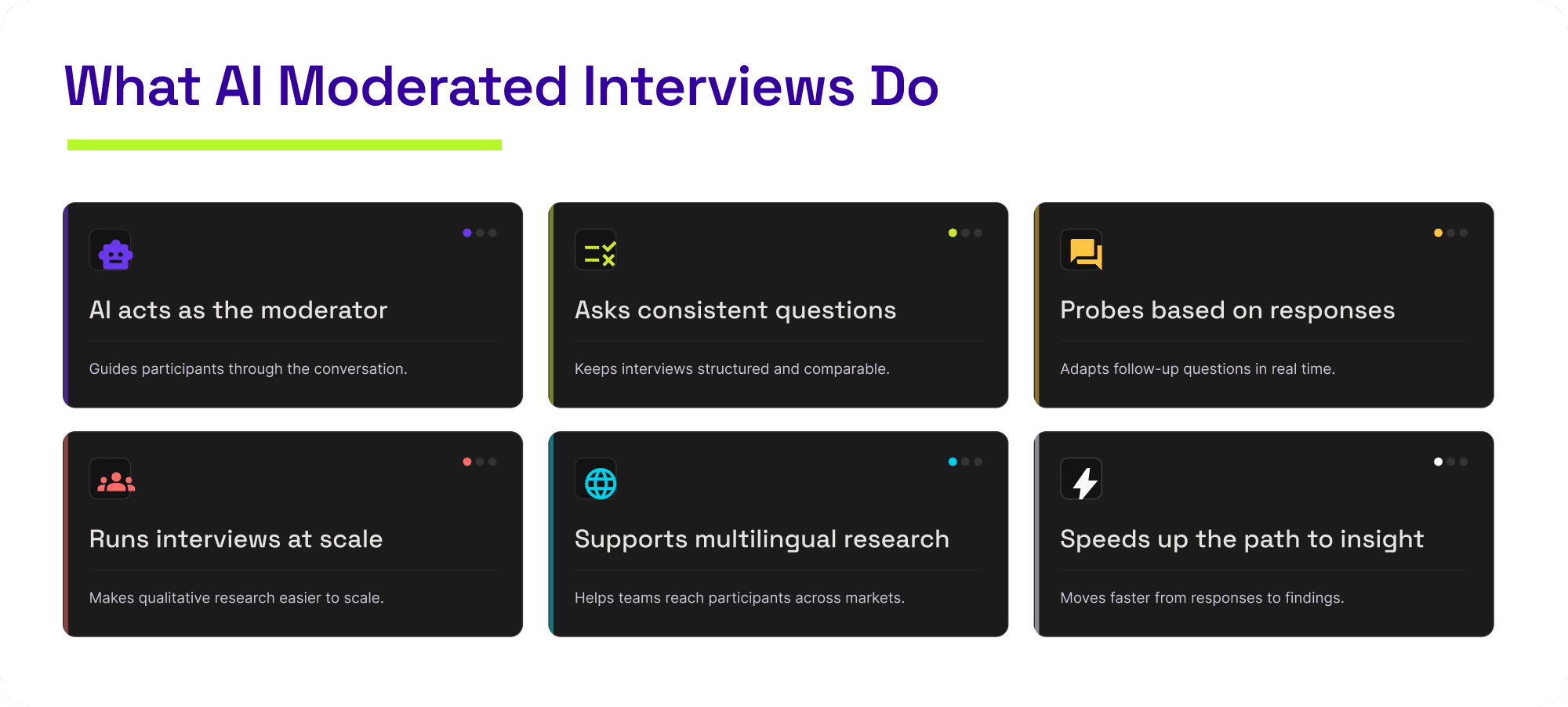
Instead of scheduling a live moderator for every session, teams can use AI to:
ask consistent questions
probe based on participant responses
run interviews at scale
support multilingual research
speed up the path from data collection to insight
In practice, AI moderated user interviews work best when teams need richer feedback than a survey can provide, but also need more speed, efficiency, or scale than traditional moderated interviews allow.
AI Moderated Interviews vs Human Moderators
The real question is not whether AI is always better than human moderators. It is whether the method fits the research objective.
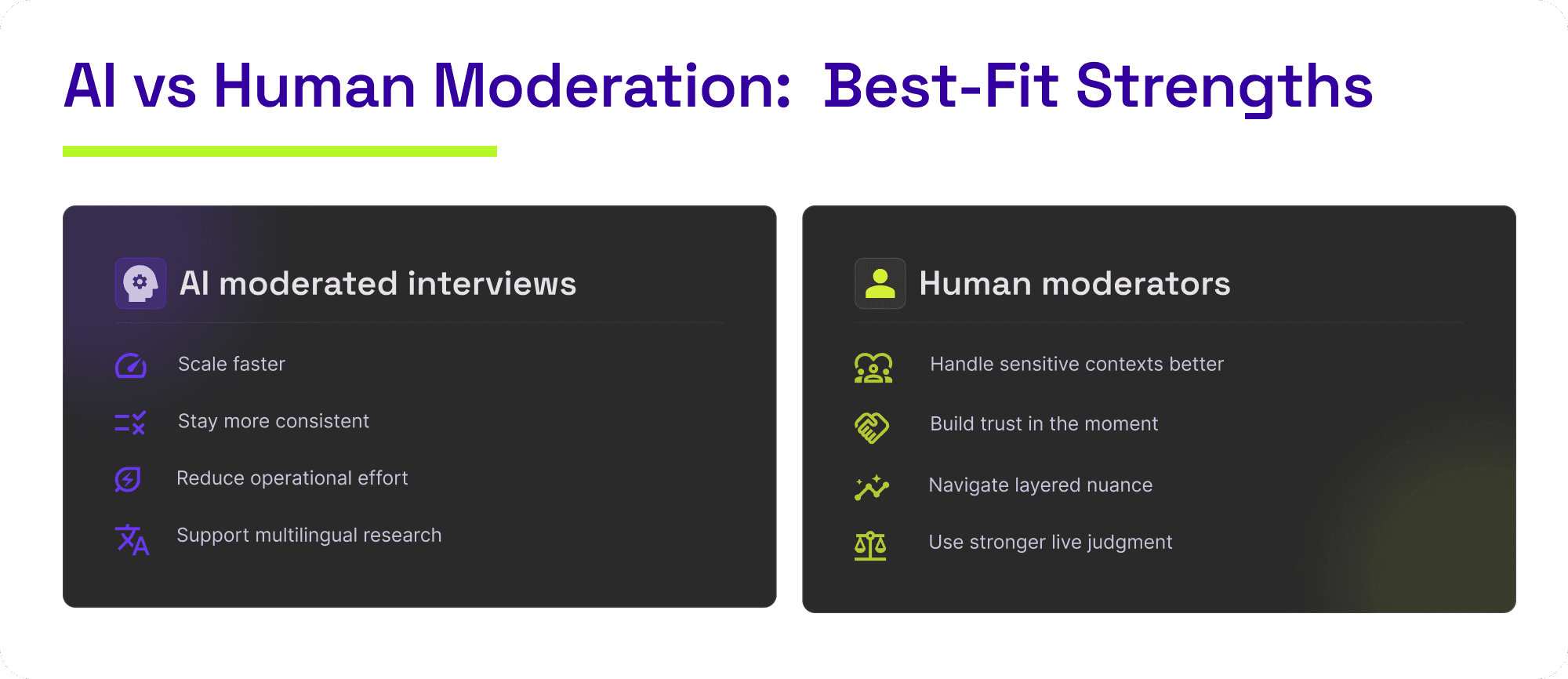
1. Speed and scale
This is one of the clearest strengths of AI moderated interviews.
Human-moderated interviews take time to recruit, schedule, conduct, and review. That works well for smaller, deeper studies, but becomes harder when teams need larger samples or faster turnaround.
AI can help teams run many interviews in parallel, often across multiple markets or time zones, without increasing moderator workload in the same way.
If the priority is scale, speed, or operational efficiency, AI often has the advantage.
2. Consistency across interviews
Human moderators bring judgment and empathy, but they also introduce natural variation. Different moderators may probe differently, frame follow-ups differently, or influence tone across sessions.
AI can make moderated interviews more consistent by applying the same questioning logic across participants. That can be especially useful when teams want more standardized data collection or need comparability across groups.
3. Cost and operational effort
Traditional qualitative research interviews are resource-intensive. Recruiting, scheduling, moderation time, note-taking, and synthesis all add cost.
AI qualitative research can reduce some of that operational burden. It allows teams to run more interviews without expanding moderator hours linearly, which can make qualitative work more accessible for frequent or large-scale studies.
4. Sensitive contexts and live interpersonal judgment
This is where human moderators can still matter a great deal.
AI moderated interviews can support rich qualitative feedback and help teams capture patterns at scale. But in highly sensitive, emotionally delicate, or relationship-heavy conversations, human moderators may still be the better fit.
A strong human moderator can build trust in the moment, adjust tone carefully, and respond to vulnerability with live interpersonal judgment.
That is especially true when the research topic involves:
personal vulnerability
trauma or sensitive health topics
high-stakes interpersonal dynamics
strategic conversations requiring strong live judgment
This distinction matters. It is not that AI cannot contribute to emotional understanding. It is that some contexts require a level of human presence and delicacy that still makes live moderation the better choice.
5. Probing and adaptability
AI can adapt and follow up, which is why conversational AI research has gained attention. It is no longer just about static scripts. Well-designed systems can ask relevant follow-up questions, identify themes, and keep the conversation moving.
Still, there is a difference between adaptive logic and live human judgment. Human moderators may still have an advantage in highly layered conversations where reframing, delicate follow-up, or relationship-based trust are especially important.
6. Global and multilingual research
For distributed studies, AI can be especially useful. Teams that need to collect insight across markets may find that AI qualitative research helps reduce coordination complexity and broaden access.
This makes AI moderated interviews attractive when the goal is to hear from more participants across regions without making the study operationally unmanageable.
When AI Moderated Interviews Work Best
AI is not best for every study. But there are clear situations where AI moderated interviews can be the stronger choice.
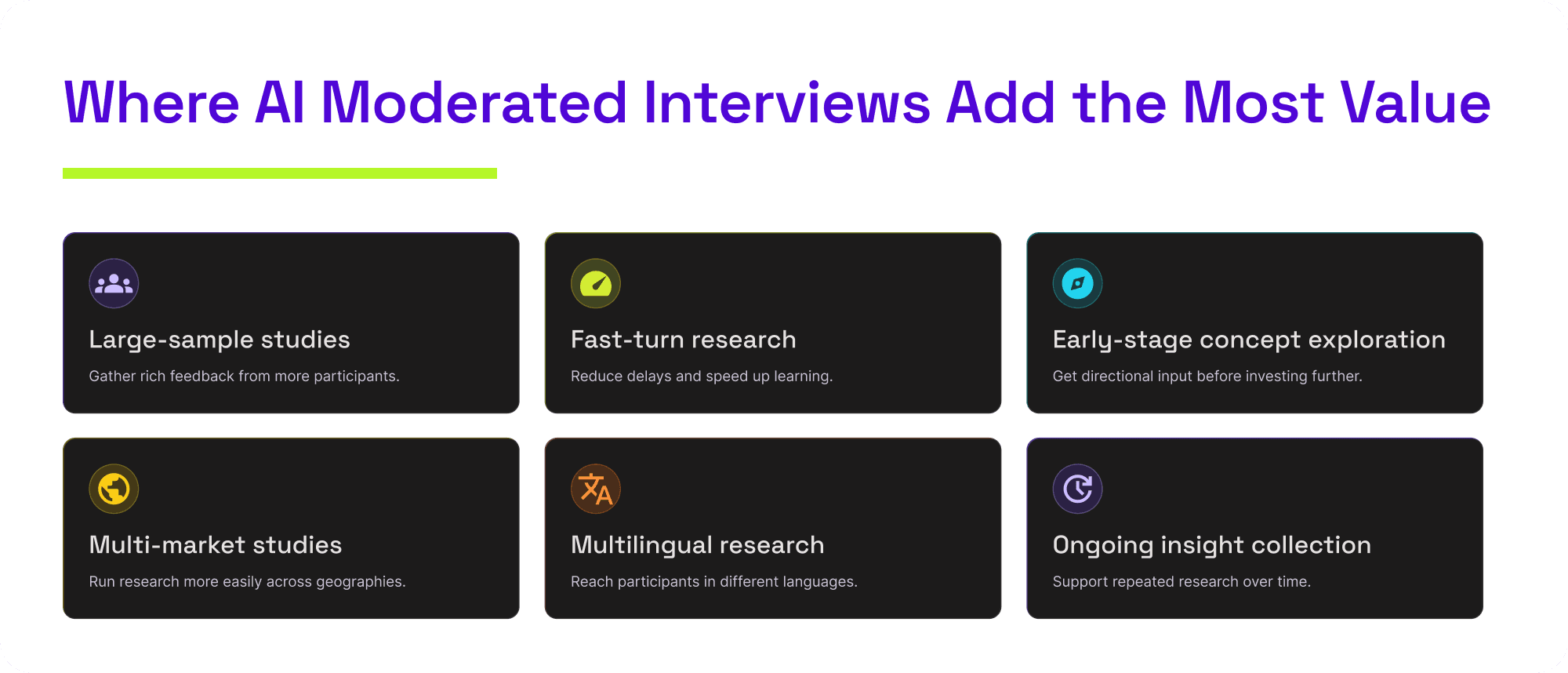
Large-sample qualitative studies
When teams want open-ended feedback from many participants, AI helps make qualitative research more scalable.
Fast-turn research
If the team needs answers quickly, AI can reduce delays tied to scheduling and moderation capacity.
Early-stage concept exploration
AI can be useful when teams want directional feedback on messages, concepts, experiences, or ideas before investing further.
Multi-market or multilingual studies
When research needs to run across geographies, AI can help make execution simpler and faster.
Repeated or ongoing insight collection
AI qualitative research is especially helpful when teams want to run interviews regularly, not just as one-off projects.
In these situations, AI helps teams get more from qualitative research interviews without carrying the full operational burden of human moderation every time.
When Human Moderators Are Still Better
There are also clear cases where human moderation remains the better method:
sensitive topics
deep exploratory work
strategic stakeholder conversations
highly complex narratives
In these cases, trust-building, reframing, and interpersonal judgment matter more. So the choice is not simply AI or humans. It is about fit.
Should Teams Use AI or Human Moderators, or Both?
For many teams, the best answer is not one or the other. It is both.
A hybrid approach can work well:
use AI for scale, speed, and broader directional insight
use human moderators for deep nuance, sensitive conversations, and richer exploratory work
This lets teams build a stronger research system overall.
For example, a team might use AI moderated interviews to gather broad qualitative input across many participants, then use human moderators to go deeper on key themes, tensions, or segments that need more nuanced exploration.
That kind of combination makes AI qualitative research more practical. It does not force teams to choose one method for every objective. It lets them use the right tool for the right question.
How to Choose the Right Method
When deciding between AI and human moderators, teams should ask:
How many interviews do we need to run?
How fast do we need the insight?
How sensitive is the topic?
How much nuance do we need?
Do we need standardized consistency across sessions?
Are we running in one market or many?
Is this exploratory, evaluative, or ongoing research?
If the study demands scale, speed, and consistency, AI may be the better fit.
If it demands sensitive live handling, deep improvisation, and layered interpretation, humans may be the better fit.
If it demands both, a hybrid model is often the smartest choice.
How Decode by Entropik Supports AI Qualitative Research
For teams exploring AI qualitative research, Decode helps make AI moderated interviews more practical and scalable.
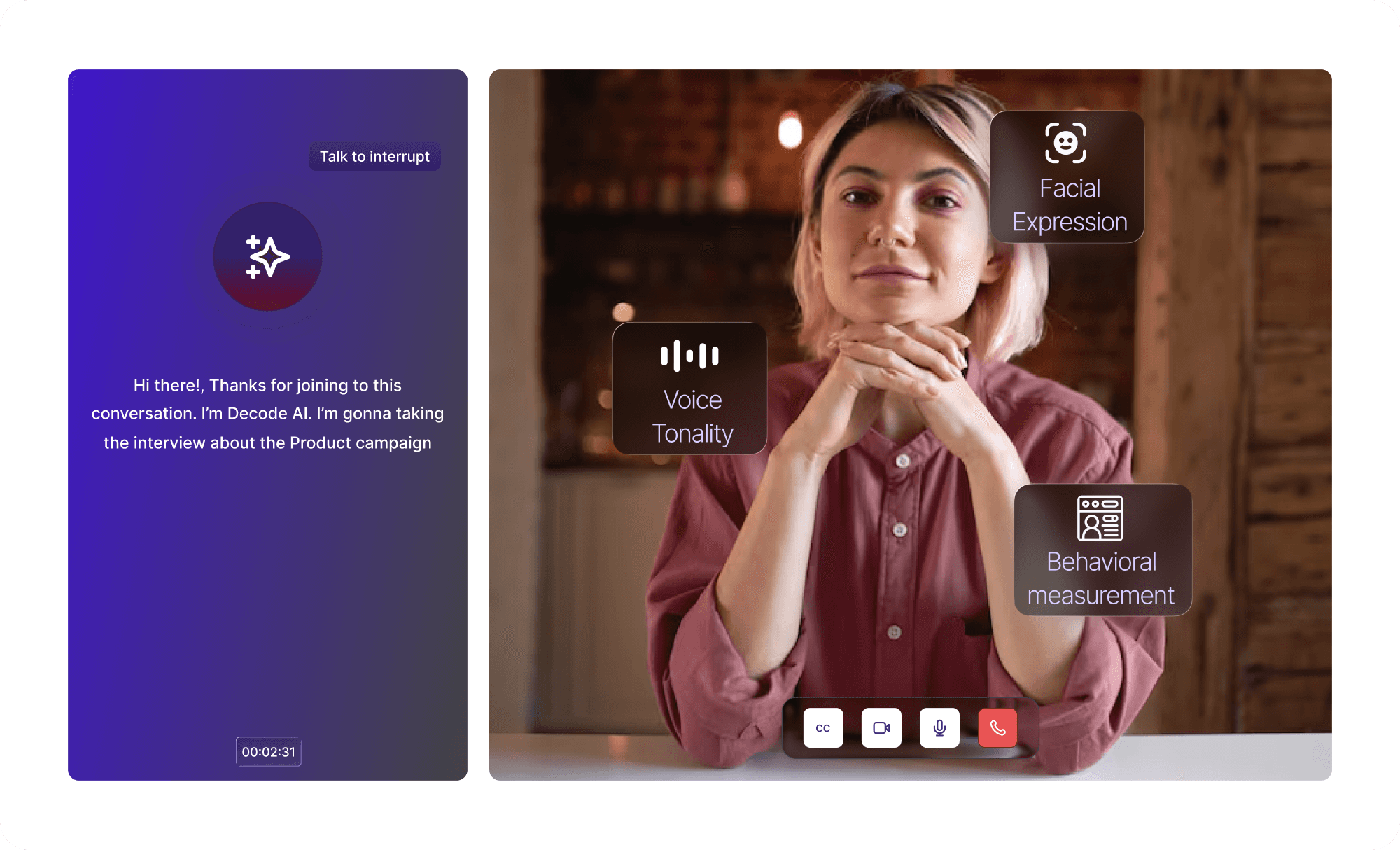
With Decode AI Moderator, teams can:
scale qualitative research by conducting hundreds of interviews simultaneously
capture emotional and behavioral signals to better understand how participants respond beyond what they explicitly say
use adaptive questioning that adjusts based on participant responses
eliminate human moderator bias and leading questions
enable 24/7 interview capability so participants can respond anytime, anywhere
run studies with multilingual support across 70+ languages
access real-time insight generation as interviews complete
This makes AI qualitative research more useful for teams that need faster turnaround, broader reach, richer understanding, and more actionable insight without depending entirely on manual moderation.
Final Thoughts
The future of qualitative research is not about choosing AI instead of humans in every case. It is about choosing the right method for the research goal.
AI qualitative research gives teams a new way to run qualitative research interviews with more speed, scale, and consistency. Human moderators still bring depth, empathy, and nuance that matter in many kinds of research. And in many cases, the best answer is a thoughtful mix of both.
Teams that understand where AI moderated interviews fit best will be better positioned to move faster, learn more efficiently, and make stronger research decisions.
Frequently asked questions
1. In what situations do AI-moderated interviews outperform human moderators?
AI moderation often outperforms in scenarios requiring scale, consistency, and speed, such as running hundreds of standardized interviews across multiple markets simultaneously.
2. Does AI moderation reduce interviewer bias compared to human moderators?
Yes, AI moderation can reduce certain biases since it asks questions consistently without the subtle influence a human moderator's tone or reactions might introduce.
3. What are the limitations of AI-moderated interviews compared to human ones?
AI may lack the deep empathy, adaptive intuition, and ability to build rapport that skilled human moderators bring to sensitive or complex conversations.
4. How do participants typically respond to AI moderators compared to humans?
Some research suggests participants may share more candidly with AI due to reduced social pressure, though comfort levels vary by individual and topic sensitivity.
5. What quality checks should be applied to AI-moderated qualitative research?
Quality checks should include reviewing a sample of AI-conducted interviews for coherence and relevance, and validating that follow-up questions appropriately probe key themes.
Related Topic: