Out-of-home (OOH) advertising is any advertising that reaches people outside their homes, including billboards, transit ads, airport displays, and digital screens. Because viewers typically have only a few seconds to absorb the message, OOH creative relies on simplicity, clarity, and strong visual focus to build brand visibility and recall.
Digital media is everywhere, but some of the most attention-grabbing ads are still found in the real world. People notice them as they commute, shop, travel, or walk through public spaces. This is where OOH advertising excels out.
OOH helps brands build visibility, support recall, and reach people where they actually live and move. Unlike most channels, it can scale without needing clicks, scrolling, or opt-ins. And the numbers back this up - global OOH ad spending hit $49.8 billion in 2025, with the market projected to grow from $25.8 billion in 2026 to $58.8 billion by 2034 at a 10.85% CAGR, according to Fortune Business Insights.
OOH is more than just billboards. It includes a wide range of formats, planning decisions, creative challenges, and measurement questions that many people overlook.
In this article, we'll explain what OOH advertising is, how it works, the main formats brands use, real-world examples, the benefits and limits of OOH, and how brands plan, measure, and test creative before launch.
What is OOH advertising?
OOH stands for out of home advertising. It means reaching people with ads when they are outside their homes, usually in public or shared spaces.
In practical terms, this includes ads people see while they are:
driving
commuting
walking in urban areas
shopping
traveling
moving through public venues
This is why OOH is frequently associated with outdoor advertising, but the category goes beyond just traditional billboards.
Put simply, OOH is advertising placed in the physical world to reach people as they move through it.
Unlike channels that rely on direct interaction, OOH typically works through:
visibility
repetition
location relevance
message simplicity
memorable creative
This is also why OOH plays a different role than digital media. It may not be measured as directly as paid search or performance ads, but it is highly effective for awareness, reach, mental availability, and campaign reinforcement. According to OAAA and Solomon Partners, OOH produces the highest consumer recall of any media channel at 86%, outperforming radio, podcasts, online ads, and TV streaming.
Types of OOH advertising
OOH advertising comes in several types, each fulfilling different goals based on audience, location, timing, and creative style.
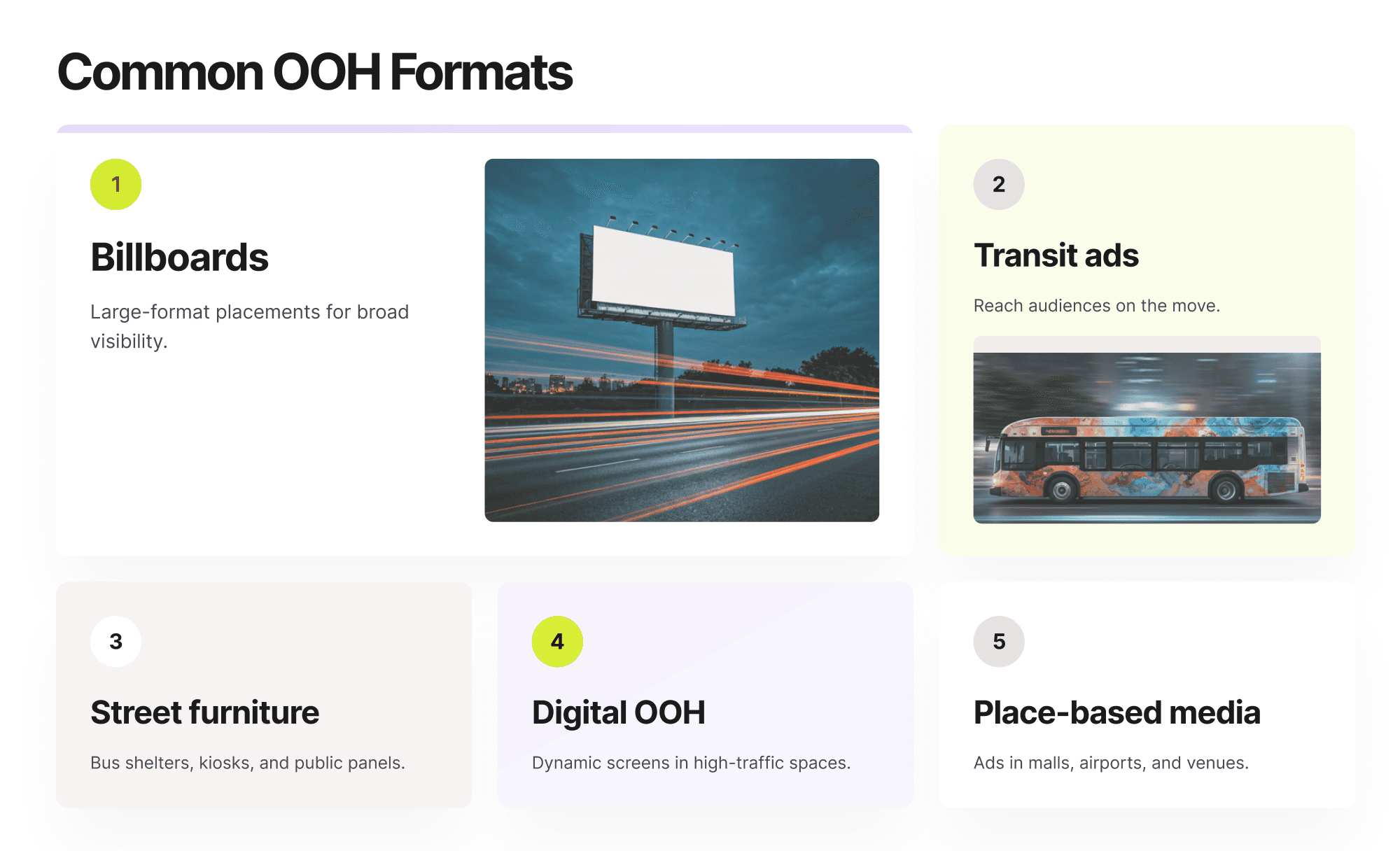
Billboard advertising
Billboard advertising is one of the most familiar OOH formats. These large placements are designed for high visibility, often in heavy-traffic areas like highways, major roads, or city centers. Billboards remain the dominant OOH format, the OAAA reported that 74.5% of US OOH revenues came from large-format ads in Q1 2025.
Billboards work best when the message is:
simple
bold
easy to read quickly
visually clear from a distance
Transit advertising
Transit ads appear on or around buses, trains, metro systems, taxis, and transit shelters. These formats help brands reach people during daily routines and repeated commutes. Transit has become one of the fastest-growing OOH segments, rising 9.2% year-over-year in 2025, making it a particularly useful format for brands that want consistent urban exposure.
Transit advertising is often useful when brands want:
high urban visibility
geographic concentration
repeated exposure
strong audience movement coverage
Street furniture advertising
This includes placements on bus shelters, kiosks, benches, and other public structures. These formats are usually seen at closer range than billboards, so they can include a bit more detail.
Place-based advertising
Place-based OOH appears within environments such as:
airports
malls
retail spaces
gyms
office buildings
entertainment venues
This type of OOH is especially useful when the environment adds relevance to the message. Place-based formats posted 8.3% year-over-year growth in Q3 2025, per OAAA data, reflecting growing brand interest in reaching audiences in contextually relevant settings.
Digital out of home advertising
Digital OOH, or DOOH, uses digital screens instead of static printed placements. Brands can update creative more easily, rotate messages, adapt content by time or location, and run more dynamic campaigns. The shift toward digital formats is accelerating fast, DOOH already accounts for 41% of total OOH spending, and programmatic DOOH ad spending is projected to grow 22.6% year-over-year and reach $1.22 billion in 2026, according to StackAdapt.
Still, the basic rule applies: people see the ad quickly and often while moving, thus clarity is critical.
OOH advertising examples
The best OOH ads are usually simple. They communicate clearly and quickly in context.
A few common examples include:
A billboard with one strong message
A brand launching a new product might use a billboard with:
a bold product visual
a short headline
one clear brand cue
This works because people usually have only a few seconds to process the ad.
Transit advertising for local relevance
A delivery app or telecom company may use buses or metro ads across a city to build visibility among frequent commuters. The frequent exposure can support message recall over time. Research from Nielsen and the OAAA shows OOH delivers average recall rates exceeding 80%, with 75% of travelers reporting they recalled seeing a digital billboard in the past month.
Retail or mall placements
A consumer brand might use screens or posters inside malls to reach shoppers close to purchase. These placements work well when the message supports product visibility, seasonal offers, or in-store action. Retail remains the largest end-use segment in OOH, accounting for 31.6% of market share in 2025.
Airport campaigns
Airports are frequently selected for premium or business campaigns because they offer long dwell time and concentrated audience access. Airport advertising is also one of the fastest-growing OOH sub-formats, projected to expand at a 6.62% CAGR through 2031.
Context-driven outdoor advertising
Some of the strongest outdoor ads use the environment to strengthen the message. Weather-related campaigns, location-based visuals, or culturally relevant placements often work better because they feel connected to the moment.
In general, effective OOH examples tend to share a few things:
clear visual hierarchy
limited copy
fast comprehension
strong branding
message relevance to the environment
Benefits of OOH advertising
OOH advertising matters because it offers multiple practical benefits for brands.
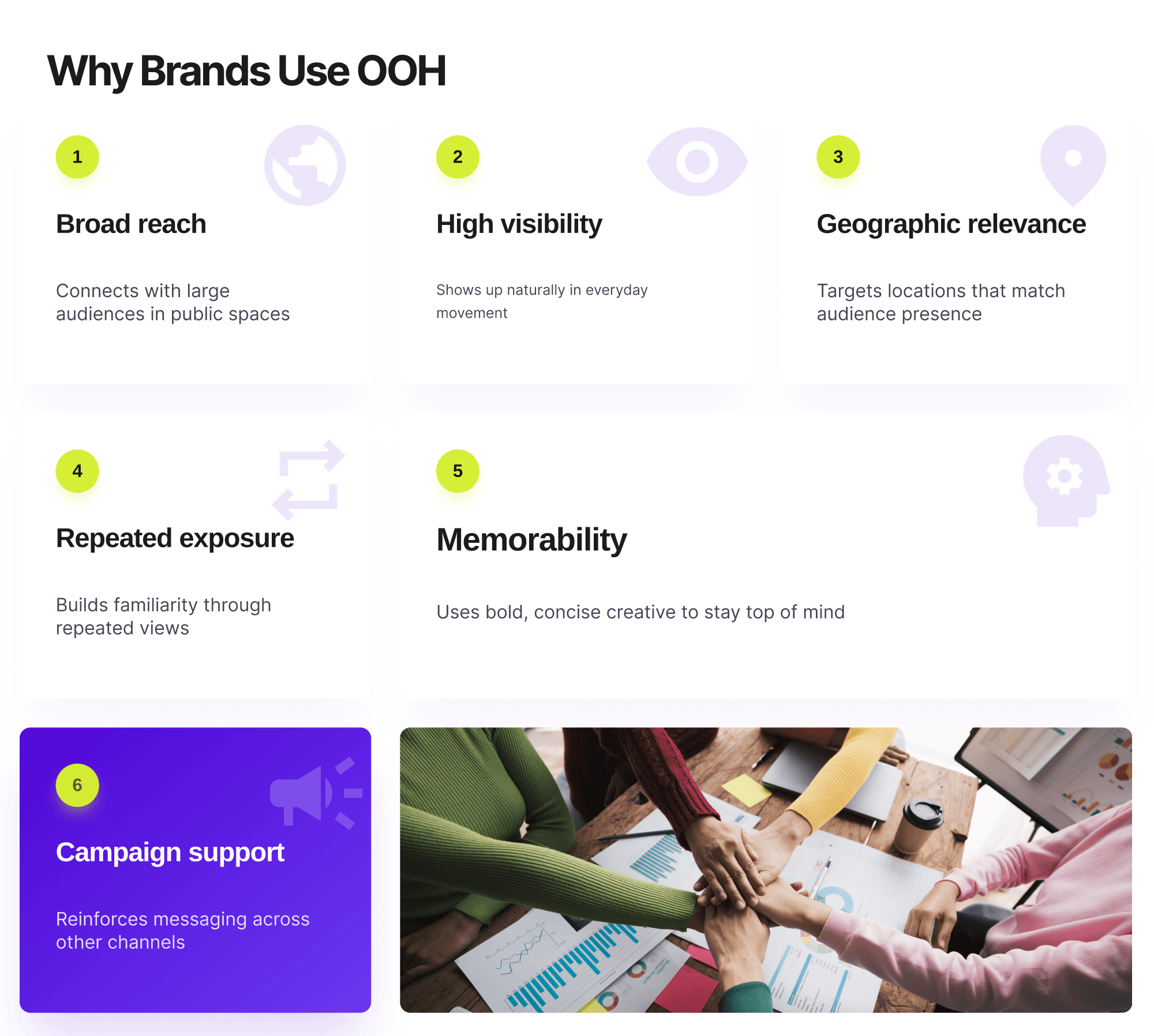
Broad reach
OOH helps brands reach large audiences in public spaces without relying on platform-specific behavior. Nearly 90% of adults report noticing an OOH ad within the past month, making it one of the most broadly visible media channels available.
Visibility
It's hard to ignore a well-placed outdoor ad in a high-traffic location. OOH works because it is part of everyday movement and unlike digital formats, it cannot be skipped or blocked.
Geographic relevance
Brands can pick locations that match where their audience is, the retail context, or city-level targeting.
Repeated exposure
People who commute or take the same routes often see the same ad multiple times. That repeated exposure builds familiarity and recall. A Kantar and Clear Channel Outdoor study found that OOH delivers a significant 13.3% increase in ad awareness compared to digital media and TV, a direct result of consistent exposure in high-traffic environments.
Memorability
Well-designed OOH creative leaves a strong impression by using strong visuals and succinct communication. OAAA and Solomon Partners research found OOH produces the highest ad recall of any media format at 86%, while Nielsen data shows OOH achieves a 47% brand recall rate compared to just 35% for digital media.
Strong ROI
OOH consistently delivers returns that justify the spend. OAAA research found that for every $1 spent on billboard advertising, brands typically see a $6 return. Adding outdoor to a mobile ad campaign can boost overall ROI by as much as 316%, and research from Analytic Partners and the OAAA shows that adding OOH to a digital media plan increases overall campaign effectiveness by more than 40%.
Campaign support
OOH is often used with digital, social, video, and retail campaigns. It reinforces broader messaging and increases harmony across channels. A 2025 study by Reveal, analyzing campaigns across 10+ markets and more than 400,000 participants, found that combining multiple OOH formats boosts campaign lift by 50–100%, with audiences exposed to both formats up to 2.5x more likely to engage.
These are some of the clearest benefits of OOH. The channel is most valuable when brands want visibility, salience, and a prominent presence in the physical world.
Limitations of OOH advertising
OOH can be powerful, but it also has clear limitations.
Limited message space
People see outdoor ads quickly, so there's little room for complexity. If the creative tries to say too much, the message may not land.
Context dependency
Placement matters. A strong creative idea may still underperform if it appears in the wrong location or reaches the wrong audience context.
Measurement challenges
Attribution is one of the biggest challenges in OOH. Brands frequently depend on modeled, directional, or mixed-signal measurement instead of straightforward click-based tracking. A recent survey found that more than 29% of brands still struggle to achieve reliable attribution, while 59% of marketers still buy OOH inventory only through direct deals, reflecting how adoption of more sophisticated measurement tools continues to lag behind interest.
Creative constraints
Because viewing time is short, the creative has to work fast. This puts pressure on simplicity, readability, contrast, layout, and visual focus.
Environmental variation
Lighting, motion, distance, weather, and clutter all affect how an ad is seen.
These are some of the clearest limitations of OOH. The channel can be highly effective, but it demands strong planning and sharper creative discipline than many teams expect.
How brands approach OOH media planning
Strong OOH media planning is not only about buying space. It's about pairing the right message to the right location, audience, and campaign goal.
Brands usually think through numerous factors.
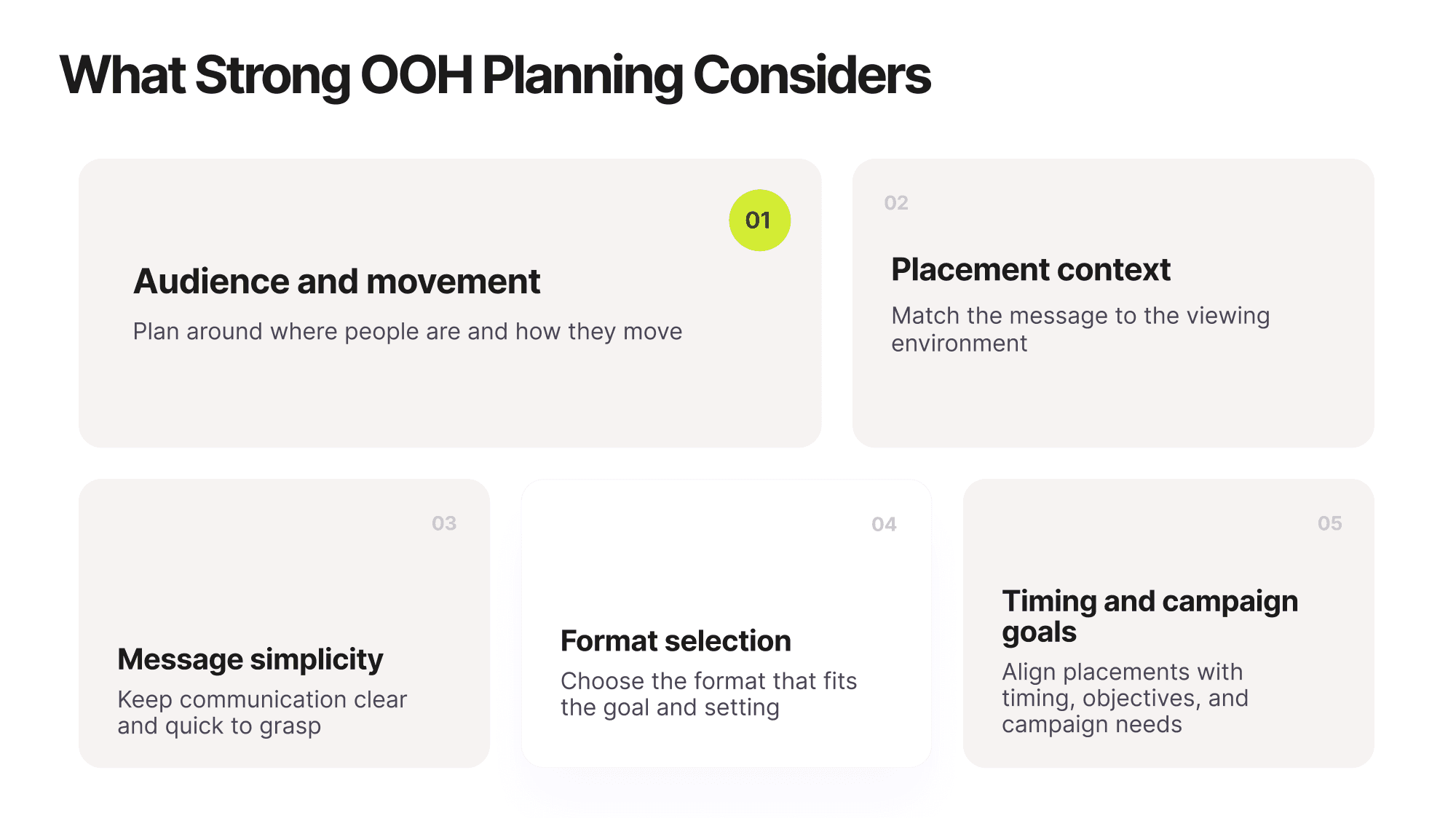
Audience and movement
Where is the expected audience likely to be? Are they commuting, shopping, traveling, or spending time in specific public areas? Today, mobile location data and AI-enabled audience targeting are making it possible to answer these questions with far greater precision. By 2026, AI is being applied across the full OOH campaign lifecycle from automated optimization and audience forecasting to context-aware creative selection.
Placement context
What will be happening when the audience sees the ad? A message seen at highway speed needs a different creative approach than one seen at a transit shelter or retail screen.
Message simplicity
Because OOH is a quick-consumption medium, the creative needs to communicate almost instantly. Planning and creative decisions should work together.
Format selection
Billboards, transit ads, retail screens, and place-based placements each serve different purposes. The format ought to match both the message and the viewing conditions. In-store retail media is expected to account for 55.9% of total DOOH growth between 2025 and 2029, making format decisions increasingly tied to purchase-proximity goals.
Timing and campaign goals
Some campaigns use OOH for broad awareness. Others use it to support product launches, reinforce seasonal promotions, or raise visibility in specific regions. EMARKETER projects a 3.6% lift in OOH ad spending for 2026, driven in part by major global events that push brands to invest in high-impact physical presence.
Good planning does more than improve reach. It increases the chances that the message will be seen, understood, and remembered.
How OOH advertising is measured
A common question brands ask is how to measure OOH advertising.
Measurement in OOH is less direct than in digital channels, but it still has structure and it's improving rapidly. Brands usually look at a mix of signals based on campaign objectives.
Visibility and likely exposure
One part of OOH measurement is estimating how many people are likely to see the ad based on location, traffic, and placement conditions.
Recall and memorability
Brands want to know if people noticed the ad and if it stayed with them. This matters most for information campaigns. OAAA and The Harris Poll found that after seeing a DOOH ad, 76% of consumers took some form of action including visiting a restaurant (36%), having a word-of-mouth conversation (30%), or visiting a store (29%).
Campaign lift
Some teams look for lift in metrics similar to:
brand awareness
search activity
store visits
purchase consideration
regional response
A Kantar study in partnership with Clear Channel Outdoor confirmed OOH outperforms CTV and digital channels on ad awareness, brand favorability, and purchase intent.
Footfall and behavioral signals
Sometimes, brands connect outdoor advertising measurement to store traffic, mobility signals, or other downstream behaviors. In 2026, anonymized mobile location data is increasingly being used to link ad exposure directly to physical store visits, bringing a level of attribution that was previously unavailable in traditional OOH.
Cross-channel impact
OOH is often a component of a broader media mix. Its value can also show up in how it reinforces other campaign channels. Keen Decision Systems research released in late 2025 showed that OOH delivers substantially higher marginal returns on investment than many heavily saturated digital channels despite representing less than 1% of total media spending.
When people ask how OOH is measured, the answer is rarely just one metric. It's a combination of exposure, recall, behavioral signals, and broader campaign impact.
Why creative testing matters in OOH advertising
OOH gives brands very little time to communicate. That makes creative quality especially important.
A person may only see an ad for a few seconds. If the message is unclear, crowded, visually weak, or too slow to process, the campaign can lose impact quickly. Given that 80% of consumers are more likely to take action after seeing a creative, visually engaging OOH ad, the stakes for getting the creative right are high.
This is where creative testing matters, especially when brands need to know if an OOH ad will communicate clearly in real life conditions.
Brands frequently need to know:
whether the main message is understood quickly
whether the visual hierarchy is clear
whether the branding is noticeable
whether the creative works at a glance
whether the ad is likely to support stronger recall
This also connects to billboard effectiveness. In OOH, success often depends on whether the creative lands quickly in real viewing conditions. Research shows that 55% of individuals can remember specific messages displayed on digital billboards each time they pass by, but that level of retention starts with getting the creative right before launch.
Testing reduces guesswork before launch. It helps teams see if the ad is too busy, if the focal point is clear, and if the creative communicates what it needs to in a short moment.
How Decode by Entropik helps brands test OOH creative before launch
For brands investing in OOH, this is where Decode by Entropik fits naturally into the process.
Because OOH creative has limited time and space to make an impression, teams need confidence that the ad will be seen, understood quickly, and remembered in actual-world conditions. Decode helps brands evaluate OOH creative before launch through visibility and attention analysis, so teams can better understand readability at different distances, message hierarchy, brand exposure, and how creative may perform across outdoor contexts.
This helps teams make stronger creative decisions earlier and reduces the risk of launching OOH assets that look good internally but do not land clearly in the real world.
Final thoughts
OOH advertising is still relevant and by the data, more relevant than ever. It reaches people in the physical places where they live, move, commute, and make decisions. US OOH revenue reached a record $9.46 billion in 2025, with 18 consecutive quarters of growth and digitally native brands like Apple, Amazon, Netflix, and OpenAI all increasing their OOH investments. When used well, it supports awareness, visibility, memorability, and broader campaign reinforcement.
Strong OOH work depends on more than placement. It relies on message clarity, context, planning, and creative discipline.
That's why understanding what OOH advertising is, how it works, what formats are available, and how brands evaluate performance matters. Testing creative before launch can also have a significant impact on campaign confidence.
FAQs
What is OOH advertising?
OOH advertising, or out of home advertising, refers to advertising that reaches people outside their homes in public or shared environments such as roads, transit systems, airports, malls, and city spaces.
What are the main types of OOH advertising?
Typical types include billboard advertising, transit advertising, street furniture, place-based media, and digital out of home screens.
What are some examples of OOH advertising?
Examples include roadside billboards, bus shelter posters, transit wraps, mall screens, airport placements, and other public-space advertising formats.
What are the advantages of OOH advertising?
OOH advertising can offer broad visibility, repeated exposure, geographic relevance, strong awareness value, and support for wider campaigns. Research consistently shows OOH produces the highest consumer recall of any media format at 86%, while delivering strong ROI, approximately $6 in product sales for every $1 spent on billboard advertising.
What are the disadvantages of OOH advertising?
Its main limitations encompass limited message space, measurement challenges, creative constraints, and the fact that performance depends heavily on placement and context.
How is OOH advertising measured?
OOH is frequently measured using a mix of visibility, likely exposure, recall, campaign lift, traffic patterns, and other directional signals rather than one direct performance metric. Advances in mobile location data and programmatic technology are making measurement increasingly more precise and actionable.
Why does OOH creative need testing before launch?
Because people usually see OOH ads quickly, brands need to know whether the message is clear, visible, and memorable enough to work in actual viewing conditions.
Related Topic: