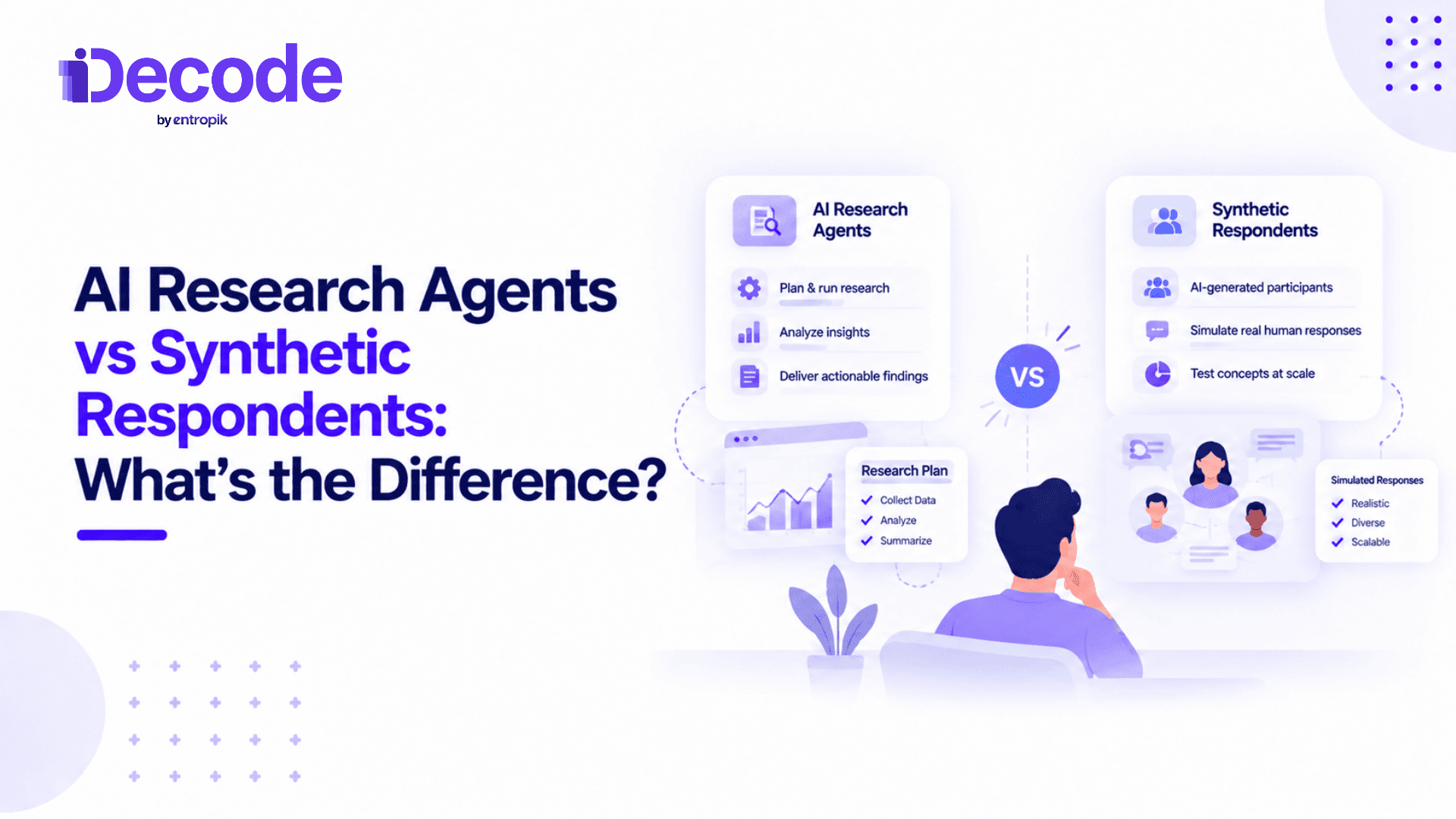
AI agents and synthetic respondents serve different roles in market research. AI agents plan, execute, and analyze research workflows, while synthetic respondents simulate how target consumers might answer questions. AI agents operate across the research process, whereas synthetic respondents act as modeled participants whose outputs should be validated against real human data.
Summary:
|
AI Agents vs Synthetic Respondents: The Key Difference
The two terms get used almost interchangeably in market research conversations, but they describe different layers of a research system.
AI research agents coordinate and execute research tasks: planning a study, moderating an interview, analyzing responses, and drafting a summary. Synthetic respondents do something narrower: they simulate what a participant might say, without being a participant at all. Agents operate at the workflow level; synthetic respondents act as a modeled source of respondent data that a workflow might consume.
The important point is that these two technologies aren't competitors. An AI research agent can just as easily orchestrate a study that uses real human participants as one that uses synthetic ones. The confusion usually comes from conflating "AI is involved" with "the data is synthetic," when those are separate questions entirely.
What Are AI Research Agents?
AI research agents are systems that interpret a research goal and carry out multiple connected tasks toward it: planning the approach, collecting data, analyzing results, synthesizing findings, and producing a report. What separates an agent from a simple automation script is that it adapts its next step based on what the previous one revealed.
Critically, agents are method-agnostic. They can work with real human respondents, synthetic data, internal datasets, or external research sources, depending on what the research question requires. Agentic AI in market research is as much about coordinating a process as it is about generating any particular kind of content.
What Are Synthetic Respondents?
Synthetic respondents are AI-generated participants designed to simulate how members of a target audience might respond to a question, concept, or stimulus. They're built by conditioning a model on demographic, behavioral, historical, or first-party data, then generating responses that reflect patterns in that data.
The key distinction to hold onto: synthetic responses model likely behavior based on existing patterns. They don't capture a new, lived reaction from an actual person. That's not a flaw so much as a different category of evidence, one that's useful for some questions and unsuitable for others, a distinction covered in more depth in why survey data alone isn't enough for understanding real consumer behavior.
AI Personas, Synthetic Users, and Digital Twins
These terms get used loosely, but they aren't interchangeable, and conflating them leads to over-trusting outputs that were never meant to carry that much weight.
AI Personas
AI personas represent defined customer profiles that researchers can query directly, useful for ideation, hypothesis generation, and early exploratory work where the goal is to surface possibilities rather than confirm them.
Synthetic Respondents
Synthetic respondents generate survey-style or interview-style answers for simulated participants, typically modeling population or segment-level characteristics rather than any one individual.
Digital Twins
Digital twins represent specific customers or segments using richer first-party data, which gives them more continuity and grounding than a generic AI persona built mostly from general model knowledge.
How AI Research Agents and Synthetic Respondents Work
Autonomy is the defining feature of an agent. Simulation is the defining feature of a synthetic respondent. Those are different jobs, and it shows in how each one actually operates.
AI Research Agent Workflow
An agent breaks a research question into tasks, selects appropriate methods or tools, executes the research steps, and adapts subsequent actions based on what it finds. Analysis and synthesis happen as connected steps in that same sequence, using AI qualitative data analysis to turn raw conversation data into structured findings faster than manual coding would allow.
Synthetic Respondent Workflow
A synthetic respondent workflow starts by defining the intended audience or persona characteristics, generates simulated responses to questions or concepts, and should always end with validating those outputs against comparable human benchmarks before anyone treats them as settled.
AI Agents vs Synthetic Respondents: Side-by-Side Comparison
Purpose and Role
AI agents coordinate or automate research activities. Synthetic respondents simulate consumer responses. One is a process layer; the other is a data source.
Evidence Produced
Agents may analyze evidence collected from real people or from existing datasets, and the evidence itself can be entirely human-sourced. Synthetic respondents, by contrast, generate predicted responses rather than newly observed ones, no matter how an agent later processes them.
Level of Autonomy
Agents determine and execute multiple research steps with some independence. Synthetic respondents primarily react to prompts, stimuli, or questions, they don't initiate a research plan of their own.
Synthetic Data vs Real Respondents
Real participants provide something a model can't manufacture: newly observed opinions, emotions, experiences, and the occasional unexpected reaction that reshapes what a study was even asking. Synthetic respondents generate responses from patterns already represented in a model or its grounding dataset, which means they can only reflect what's already been captured somewhere, not what's genuinely new.
Stanford University's research on generative agent simulations found that agents built from structured interviews with real people could closely replicate those individuals' answers on established social science surveys, but the same research was explicit that this fidelity was strongest for well-documented, stable attitudes rather than novel or fast-changing ones. That's a meaningful caveat: replication accuracy on familiar territory doesn't guarantee accuracy on unfamiliar territory, which is exactly where human research earns its keep, for genuinely novel, high-stakes, or emotionally complex questions.
Where Synthetic Respondents Work Best
Synthetic respondents are most useful early in a research process, before a team has committed real budget and fieldwork time.
They're well suited to early concept screening, questionnaire testing, hypothesis generation, and scenario exploration, letting a team rapidly narrow down alternatives before investing in human fieldwork. The important discipline is treating synthetic outputs directionally, as a filter, rather than as a universal substitute for primary research.
Concept and Message Pre-Testing
Synthetic respondents can compare early concepts or messages quickly, helping a team identify which hypotheses are worth validating with real consumers rather than testing everything with equal weight.
Questionnaire and Research Design Testing
Running a draft questionnaire through synthetic respondents first can surface unclear questions or weak response options, and expose possible interpretations a researcher hadn't anticipated, before the survey ever reaches a real panel.
Where AI Research Agents Add Value
Agents earn their value by automating multi-step workflows across planning, execution, analysis, and reporting, work that traditionally consumed the majority of a researcher's week. That includes desk research, competitive intelligence, qualitative studies, and recurring monitoring, and agents can work across both real-human and synthetic research inputs depending on what a given task calls for.
AI-Moderated Research With Real Participants
One of the clearest applications is using AI to conduct or support interviews while the respondent remains a real person. The agent adapts probes and follow-up questions based on what a participant actually says, preserving genuine human respondent data while automating the moderation and analysis layers around it. Agentic AI for research teams increasingly sits at exactly this intersection, coordinating the workflow without replacing the participant.
AI-Moderated Research vs Synthetic Research
These two get lumped together constantly, but they differ in a way that matters for data quality: AI-moderated research uses AI as the interviewer while collecting data from real participants, whereas synthetic research replaces the participant's response itself with a modeled, AI-generated one.
That distinction affects data provenance, freshness, validity, and the ability to discover something genuinely unexpected. A real participant can say something no one anticipated; a synthetic respondent, by construction, can only recombine what a model already knows. Reducing bias and preserving data quality in AI-moderated interviews is a solvable engineering and process problem. Reducing the ceiling on novelty in synthetic responses is a structural one.
Risks and Limitations of Synthetic Respondents
Synthetic respondents inherit the limitations of the data and models behind them, which shows up in a few consistent ways:
Dependency on historical data means they struggle with genuinely new products or emerging behaviors that haven't been documented yet
Model bias can produce stereotyped responses that flatten the real variance found in an actual population
Emotional nuance and unexpected findings are hard to simulate convincingly, since a model is predicting a plausible answer, not experiencing a reaction
Gallup's research on evaluating AI-simulated survey responses has emphasized fit-for-purpose validation as a precondition for using synthetic data responsibly, arguing that plausibility alone isn't evidence, and that synthetic outputs need to be checked against real benchmarks for the specific population and question at hand before they inform a decision. Kantar's research on AI adoption in market research has similarly found that most research professionals see synthetic tools as a complement to human fieldwork rather than a wholesale replacement, reflecting a shared industry view that plausible AI responses shouldn't be treated as equivalent to observed human evidence.
Why Synthetic Respondent Validation Matters
Validation isn't a one-time checkbox; it's an ongoing practice; comparing synthetic outputs against representative human benchmarks for the specific population, use case, and metric a study actually needs, not just a general sense that the tool "seems accurate."
That means monitoring for bias, checking for subgroup differences that a population-level accuracy score can hide, confirming genuine equivalence rather than surface-level similarity, and watching for model drift over time as underlying training data and model versions change. MIT's research on AI-generated personas has flagged that models can underrepresent minority viewpoints within a population even while matching aggregate statistics closely, which is exactly the kind of gap that only shows up when validation happens at the subgroup level, not just overall.
Can AI Agents and Synthetic Respondents Work Together?
Yes, and this combination is where a lot of the practical value shows up. Use synthetic respondents during exploratory research to move fast and narrow down options, and use AI agents to orchestrate the overall workflow around that exploration and whatever comes after it.
The discipline that makes this work is following synthetic exploration with human validation before any important decision, and clearly distinguishing modeled evidence from observed human evidence throughout analysis and reporting. A research repository that tags evidence by source makes this distinction easy to maintain instead of relying on people remembering which finding came from where.
When to Use AI Agents, Synthetic Respondents, or Real Respondents
Use AI Research Agents When
Multiple research steps or tools need to be coordinated, or existing human, market, or organizational data needs to be analyzed and synthesized rather than collected from scratch.
Use Synthetic Respondents When
The objective is rapid exploratory testing or hypothesis development, and reliable human benchmarks already exist to validate against once the exploration narrows things down.
Use Real Respondents When
The research requires genuine attitudes, behaviors, emotions, or lived experiences, or when findings will support consequential product, customer, brand, or business decisions where being wrong is expensive.
Behavioral Research With Real Participants in AI-Enabled Workflows
Behavioral research captures observed reactions from actual participants rather than predicting responses through a synthetic persona, which is precisely the gap synthetic respondents can't close. Facial expressions, eye movement, and vocal tone happen in real time and can't be convincingly fabricated by a language model working from text patterns alone.
Decode's behavioral measurement capabilities, including 90%+ facial coding accuracy, 96% eye tracking accuracy, detection across 62 facial expressions, and support for 70+ languages, are backed by 17 patents and used by more than 150 global brands. That real behavioral evidence can then feed directly into AI-assisted analysis and agentic research workflows, giving agents genuine human signal to work with rather than a purely modeled substitute. Where a study calls for it, synthetic respondents can still play a useful early-exploration role alongside this real behavioral evidence, provided the two are never presented as equivalent.
The Future of AI-Enabled Market Research
The direction of travel is convergence: AI agents, synthetic exploration, real-human research, and behavioral evidence increasingly work together within one system rather than as separate, competing approaches. Pew Research Center's work on survey methodology continues to underscore that sample validity and response quality remain foundational to credible research, a standard that applies whether the underlying data is real or synthetic.
Synthetic respondents are best understood as one input within a broader research system, not a complete substitute for talking to actual consumers. As agentic workflows mature, validation, transparency, clear data provenance, and human oversight aren't optional extras, they're what keeps a hybrid research system honest about what it actually knows versus what it's predicting.
Decode by Entropik captures behavioral evidence from real participants within AI-enabled market research workflows, backed by 90%+ facial coding accuracy, 96% eye tracking accuracy, 62 facial expressions, 70+ languages, 17 patents, and 150+ global brands. Visit Entropik to explore the consumer insights platform or request a demo to see real behavioral evidence at work in your own research.
Frequently Asked Questions
1. What is the difference between AI agents and synthetic respondents?
AI agents coordinate and execute research workflows, such as planning, analysis, and reporting. Synthetic respondents simulate how a target audience might answer a question. Agents are a process layer; synthetic respondents are a data source agents can optionally use.
2. Are synthetic respondents the same as AI personas?
No. AI personas represent queryable customer profiles used for ideation and exploration, while synthetic respondents generate survey- or interview-style answers meant to model population or segment-level response patterns.
3. What is the difference between synthetic respondents and digital twins?
Synthetic respondents typically model general population or segment characteristics. Digital twins represent specific customers or segments using richer first-party data, giving them more grounding and continuity.
4. Are synthetic respondents as accurate as real respondents?
Synthetic respondents can closely replicate well-documented, stable attitudes, but accuracy drops for novel, fast-changing, or emotionally complex questions where no real person has generated comparable data yet. Validation against human benchmarks is essential before relying on synthetic outputs.
5. Can AI research agents work with real respondents?
Yes. Agents are method-agnostic and can plan, moderate, and analyze research involving real human participants just as readily as research using synthetic data.
6. When should synthetic respondents be used in market research?
Synthetic respondents work best for early concept screening, questionnaire testing, hypothesis generation, and narrowing down options before committing budget to human fieldwork.
7. Can AI agents and synthetic respondents be used together?
Yes. A common pattern uses synthetic respondents for fast exploratory testing while an AI agent orchestrates the surrounding workflow, followed by human validation before any consequential decision.
8. Will synthetic respondents replace real research participants?
Unlikely in full. Synthetic respondents are increasingly treated as a complement to human fieldwork rather than a replacement, particularly for novel, high-stakes, or emotionally nuanced research questions.