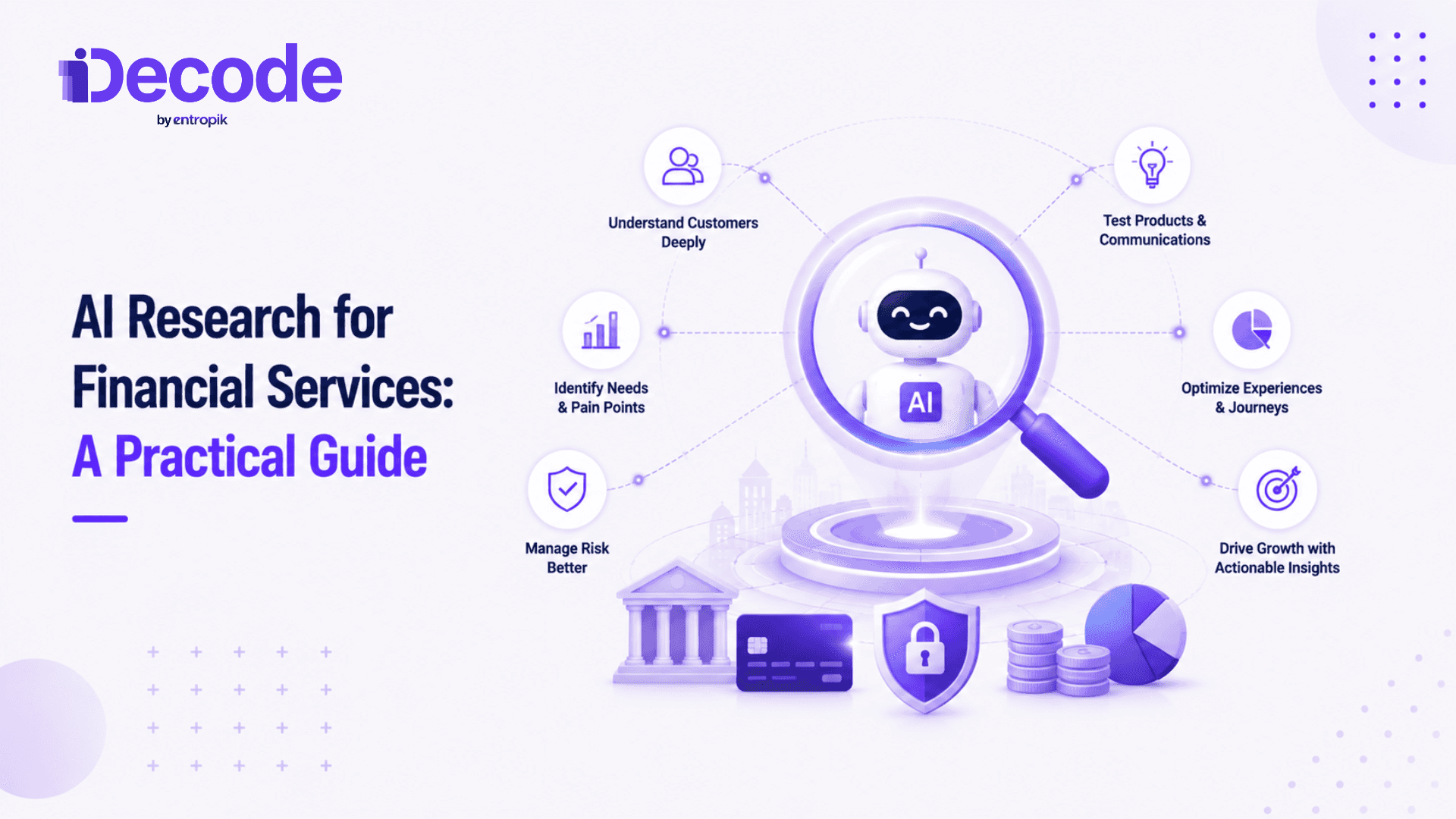
AI research for financial services uses AI to run and analyze qualitative customer research at scale for banks, insurers, fintechs, and wealth managers. It surfaces the trust, risk, and loyalty drivers behind switching and product decisions, automating recruitment, interviewing, and synthesis so insights teams get compliant, decision-ready findings in days rather than months.
Summary:
|
What Is AI Research for Financial Services?
AI research for financial services is AI-powered customer and market research built for banks, insurers, fintechs, and wealth managers. It uses an AI interviewer to run structured, one-on-one qualitative conversations with verified customers, then automatically synthesizes the findings into themes a research or product team can act on.
This is a different discipline from the broad "AI in banking" conversation that usually centers on fraud detection, credit risk models, or back-office automation. Those tools optimize operations. AI moderated user research does something else: it surfaces the "why" behind a customer's decision, at a scale that would be impractical for a team of human interviewers to reach on their own.
That distinction matters because financial services customers rarely give you the real reason for a decision on the first pass. A customer who says they left a bank "for a better rate" is usually simplifying. AI moderated interviews are built to probe past that first answer, the same way an experienced qualitative researcher would, asking what "better" actually meant and what finally tipped the decision.
Why Financial Services Teams Are Adopting AI Research
Traditional qualitative research in financial services has always been slow and expensive relative to how fast product, pricing, and regulatory cycles now move. A study that takes six weeks to field, moderate, and report cannot keep pace with a quarterly product roadmap or a compliance deadline.
There is also a deeper problem with relying on stated reasons alone. Customers rationalize financial decisions after the fact, so a survey asking "why did you switch banks" tends to return answers about fees and rates, the socially acceptable explanations, while the actual driver is often a breakdown in trust: a confusing fee, an unresolved support ticket, or a moment where the app simply did not work when it mattered.
Trust is not a soft metric in this industry. Forrester's most recent Total Experience research on US banks found that even as scores improve year over year, no bank earned an "excellent" rating across customer experience, brand experience, or noncustomer brand experience, meaning most banking relationships are still, at best, mediocre rather than genuinely trusted. That gap between "acceptable" and "trusted" is exactly what qualitative research is built to explain, and it is why more institutions are treating customer experience in financial services as a continuous listening exercise rather than an annual study.
AI research fits that shift well. Instead of one large study before a product launch, teams can run smaller, continuous rounds of research tied to specific moments in the customer relationship, onboarding, a pricing change, a support interaction, and build a running picture of where trust is strengthening or eroding.
How AI Research Works for Financial Services
The process mirrors a well-run qualitative study, with a few adaptations specific to a regulated industry.
1. Define the objective: A concrete decision the research needs to inform, such as why a specific segment cancels policies in the first 90 days, or whether a redesigned onboarding flow reduces application drop-off.
2. Screen verified customers: Participants are confirmed against actual account status, tenure, or product usage rather than self-reported demographics, which matters more in financial services than almost any other category.
3. Run AI-moderated interviews with adaptive probing: Instead of a fixed script, the AI moderator follows up on unexpected or vague answers in real time. This is where emotional laddering comes in: starting with a surface-level answer ("the app was frustrating") and asking follow-up questions that trace it back to the underlying trust or risk driver ("I wasn't sure the transfer had actually gone through"). This step-by-step guide to how AI moderated interviews actually work walks through the mechanics in more detail, and this breakdown of AI moderator versus human moderator covers how the two approaches compare.
4. Synthesize themes: AI qualitative data analysis clusters responses, surfaces representative verbatims, and flags where findings diverge by segment, cutting a reporting timeline from weeks to days.
Segmentation matters throughout this process. A finding from retail banking customers rarely transfers cleanly to wealth management clients, and insurance policyholders think about trust differently than fintech app users do. Studies that segment by product, tenure, and vertical produce findings a team can actually act on, rather than an average that describes no one in particular. For institutions operating across markets, multilingual research with AI-moderated interviews also removes a common bottleneck, since studies no longer need to wait on locally available human moderators for every language.
Financial Services Use Cases for AI Research
Each use case below ties to a specific retention, acquisition, or product outcome, not just a general interest in "understanding customers."
Switching and Churn Drivers
Account closures and policy cancellations rarely have a single cause. AI research can uncover the trust erosion and relationship failures behind a switching decision and map them in the customer's own words, producing a switching map that goes well beyond a churn dashboard. This kind of root-cause work pairs naturally with a broader look at the business impact of customer churn across a portfolio.
Digital Product and App Experience
Mobile and web banking journeys generate constant friction that usage analytics alone cannot fully explain. AI-moderated interviews diagnose why a self-service feature goes unused or why a specific step in a flow causes hesitation. Common UX mistakes in banking apps tend to repeat across institutions, and qualitative research is usually what finally makes the pattern visible to a product team.
Onboarding and Account Opening
Application abandonment is one of the most expensive friction points in financial services, since every drop-off represents an acquisition cost already spent. AI research can identify exactly where an applicant loses confidence or gets stuck, and how that moment compares to what they expected walking in. Understanding the sequence of that journey often comes back to the same discipline covered in user journey mapping in the BFSI sector.
Trust, Brand, and Product Perception
Trust in a financial brand is built and lost gradually, and AI-moderated interviews are well suited to measuring it directly rather than inferring it from satisfaction scores. Studies can test how a specific claim, fee disclosure, or product message lands, and how consideration and sentiment compare against competitors. This work connects closely to building user trust through AI-driven UX research, which looks at how digital experience choices shape that trust over time.
Ensuring Research Quality, Compliance, and Data Privacy
This is the section financial services research teams tend to scrutinize hardest, and rightly so.
Handling PII and consent.
Any platform used for financial services research needs clear, auditable handling of personally identifiable information and explicit participant consent, consistent with the data governance standards the rest of the institution already operates under.
Verified participants and fraud screening.
Sample quality problems are not unique to financial services, but the stakes are higher when a finding informs a regulated product decision. Kantar's research on panel quality found that researchers are discarding as much as 38 percent of the data they collect industry-wide because of quality concerns and panel fraud, a reminder that verification cannot be treated as optional in any research design, and even less so in a regulated one.
Representativeness and category incidence.
A sample needs to reflect the actual customer base, not just people willing to opt into a panel, and that requires the same rigor a traditional study would apply.
The researcher's role does not go away.
Guide design, objective-setting, and interpretation still require a researcher who understands both the method and the regulatory context. AI moderation changes how the interview happens, not why a study needs a clear hypothesis and governance behind it. Programs that document this discipline consistently tend to hold up better under internal or external review, a point covered in more depth in this guide to AI-moderated research data quality.
AI Research vs Traditional Financial Services Research
AI research is not a wholesale replacement for consulting engagements or agency-led studies. It is faster and more cost-efficient for the kind of continuous, iterative research most institutions actually need month to month, hundreds of adaptively moderated interviews instead of a handful of sessions spread across weeks.
Human moderation and expert analysis still add distinct value for the most sensitive or strategically complex studies, where an experienced interviewer's judgment in the room is hard to fully replace, and where findings will inform a decision with significant regulatory or reputational weight. The two approaches work best as a combined program: AI research providing the continuous, scaled listening, and human-led studies reserved for the highest-stakes decisions. This comparison of AI-moderated interviews versus focus groups is a useful starting point for deciding which method fits a given question.
How to Choose an AI Research Platform for Financial Services
A few criteria separate platforms that hold up for financial services work from ones that do not:
Turnaround time, from fielding to synthesized, decision-ready findings.
Moderation depth, meaning genuine adaptive follow-up and emotional laddering, not a scripted chatbot.
Verified sample, with real customer or policyholder confirmation and fraud screening built in.
Compliance posture, including clear PII handling, consent workflows, and data residency options where relevant.
Signal capture beyond the transcript. For app and concept testing, emotion and attention signals can reveal hesitation or confusion a participant never puts into words.
Reusability, so past studies can be compared against new ones as the research program builds over time.
Reviewing a shortlist of AI moderation platforms against these criteria, rather than a generic feature list, tends to matter more in financial services than in almost any other category, given how much rides on getting the compliance layer right from the start.
Running Financial Services Research With Decode
Decode's AI Moderator is built for structured, adaptive interviews across switching, onboarding, and product research, the exact use cases financial services teams return to most often. For app and concept testing specifically, Decode layers emotion and attention measurement on top of the interview itself, using facial coding with more than 90 percent accuracy and eye tracking with 96 percent accuracy across 62 measurable facial expressions, so a reaction to a fee disclosure or a confusing screen gets read alongside what the customer actually says about it.
Decode supports research across 70+ languages, holds 17 patents, and is trusted by 150+ global brands running consumer and customer research programs. As an AI moderator purpose-built for adaptive interviews at scale, it fits directly into the switching, onboarding, and trust research financial services teams run most. It sits within Decode by Entropik, a unified human insights platform built to bring qualitative, quantitative, behavioral, and emotional research together in one place.
Frequently Asked Questions
1. What is AI research for financial services?
It is AI-powered customer and market research for banks, insurers, fintechs, and wealth managers. An AI interviewer runs structured qualitative interviews with verified customers and automates synthesis, surfacing the trust, risk, and loyalty drivers behind switching, product, and onboarding decisions.
2. How is AI research different from traditional financial services market research?
Traditional qualitative research is limited by how many sessions a human moderator can run and typically takes weeks to field and report. AI research runs hundreds of adaptively moderated interviews in parallel and returns synthesized findings in days, while still probing for depth rather than just collecting stated answers.
3. What financial services use cases work best with AI research?
Switching and churn research, digital product and app experience diagnosis, onboarding and account opening friction, and trust or brand perception studies are the most common and highest-value applications.
4. How does AI research handle compliance and customer data privacy?
A properly built platform handles PII with clear consent workflows and auditable data governance consistent with the standards a financial institution already applies elsewhere, with verified participants and fraud screening built into the sample.
5. How fast can banks and fintechs get insights from AI research?
Most studies return synthesized, decision-ready findings in days rather than the multiple weeks a traditional qualitative research cycle typically requires.
6. Can AI research explain why customers switch banks or cancel policies?
Yes. Adaptive follow-up questions, sometimes called emotional laddering, are specifically designed to move past a customer's first, often rationalized, answer and reach the underlying trust or risk driver behind the decision.
7. How does AI research ensure participants are verified customers?
Participants are screened against actual account status, product ownership, or tenure rather than self-reported demographics alone, with fraud detection applied to filter out low-quality or ineligible respondents before interviews begin.
8. What are the limitations of AI research in financial services?
It works best as part of a broader research program rather than a full replacement for expert-led studies on the most sensitive or highest-stakes decisions, and its value still depends on sound guide design, proper segmentation, and governance, the same fundamentals that make any research program reliable.
Financial services customers rarely explain their real reasons for staying, switching, or hesitating in a survey. AI research gives insights teams a way to reach those reasons directly, with the compliance and verification a regulated industry requires, at a speed that finally matches the pace of the product and pricing decisions research needs to inform.
Related Topics: