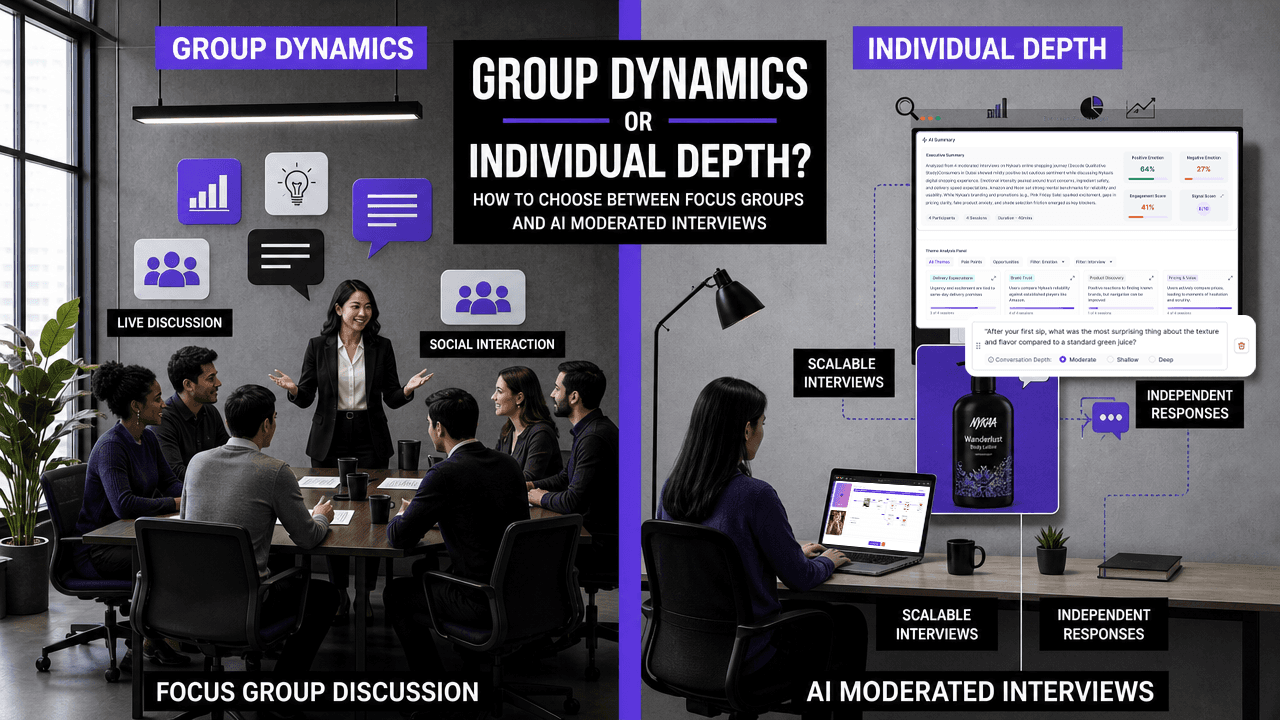
AI moderated interviews focus on individual, one-on-one responses without the influence of group dynamics, while focus groups bring multiple participants together to observe how opinions build, shift, or clash in a shared setting. Focus groups are stronger when interaction itself is valuable; AI moderated interviews are better for capturing private, independent reactions at greater scale and consistency.
Why This Choice Matters More Than It Looks
Research teams often choose between methods that seem similar on the surface but behave very differently in practice. That is especially true when deciding between focus groups and interview-based qualitative research.
Both can help teams understand reactions, motivations, and unmet needs. Both can generate open-ended feedback. Both can support early exploration before larger investments are made.
But they are not interchangeable.
The real difference is not simply format. It is the kind of insight each method is designed to produce. Focus groups rely on group interaction. Interviews rely more on individual reflection. Once teams understand that difference, the method choice becomes much clearer.
This is where the focus group vs interview decision becomes important. And in that comparison, AI moderated interviews create a new option for teams that want individual qualitative depth without the operational weight of live moderation for every session.
What Focus Groups Are Designed to Do
Focus group research is built around interaction.
A focus group discussion brings multiple participants together so researchers can observe not just individual opinions, but how those opinions shift, build, or clash in a shared setting. That group dynamic is often the main reason to use the method.
This is where group interviews can be especially valuable. Participants may react to each other’s comments, build on ideas, challenge assumptions, or surface shared language that would be harder to capture in a one-to-one setting.
That makes focus groups useful when teams want to:
explore how opinions form in a group
observe live reactions shaped by discussion
understand collective language and framing
test ideas that may benefit from debate or social interaction
In other words, the strength of the focus group method is not just that many people are involved. It is that participants influence each other in ways that can reveal useful dynamics.
What AI Moderated Interviews Are Designed to Do
AI moderated interviews are designed for a different kind of qualitative input.
Instead of relying on group interaction, they focus on individual responses. Participants move through a guided conversation where questions can adapt based on what they say. That makes the method better suited to capturing personal reactions without the social influence that often shapes a group setting.
In practice, this places AI-moderated interviews closer to qualitative interviews than to focus groups. The difference is that AI can help teams run those interviews at greater scale, with more consistency, and often with less operational effort than fully manual live moderation.
This makes AI-moderated interviews especially useful when teams want to:
hear how individuals interpret an idea on their own
reduce social pressure in responses
keep probing more consistent across sessions
gather exploratory input faster
run more interviews without scaling live moderator effort at the same rate
So the method is not trying to recreate a focus group. It is solving a different research need.
AI Moderated Interviews vs Focus Groups
This is where the focus group vs interview comparison becomes more useful.
The best choice depends on what kind of research signal matters most.
Group dynamics vs individual depth
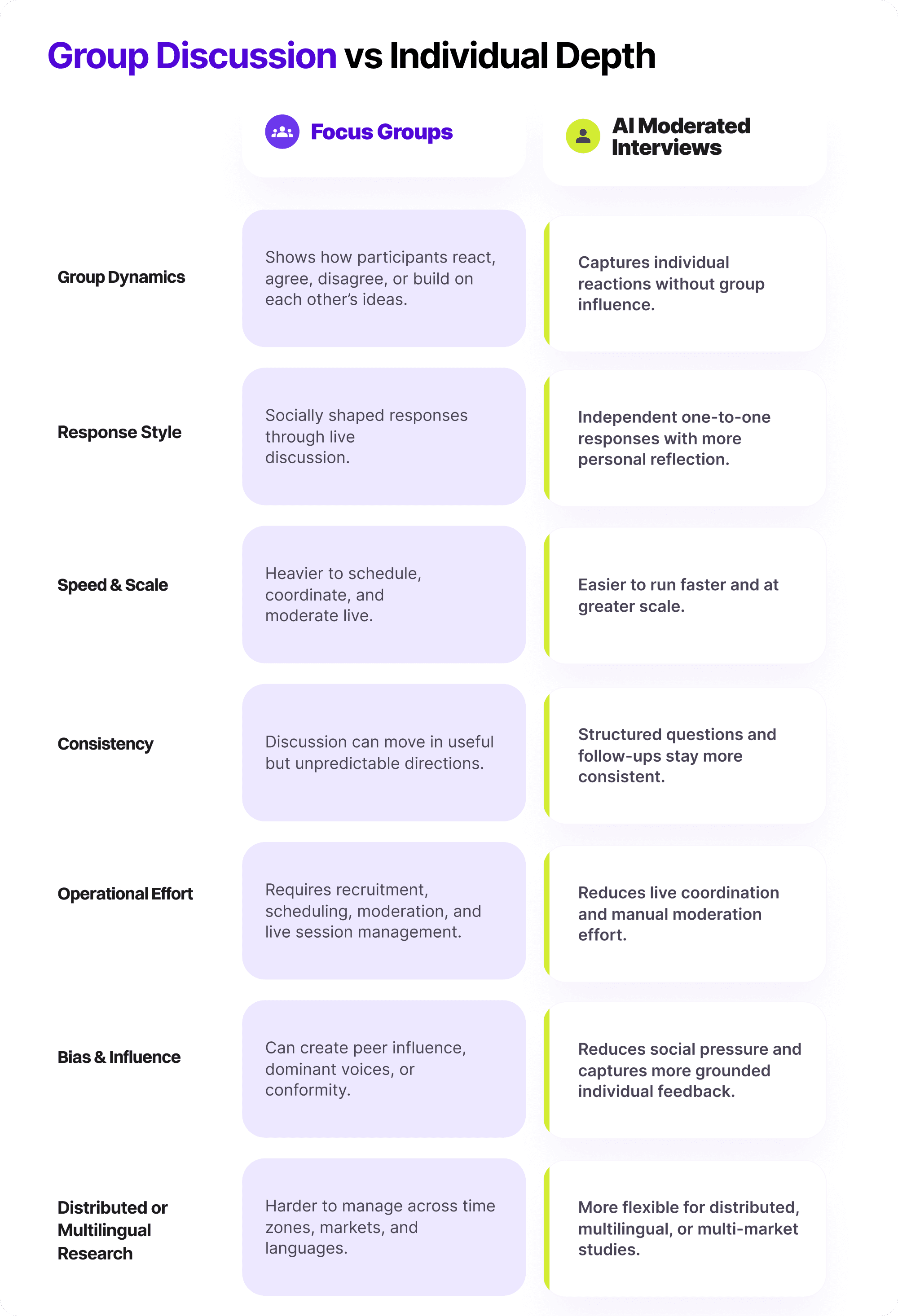
Focus groups are stronger when the interaction between participants is itself valuable. If you need to see how people respond to each other, agree, disagree, or shape group thinking, focus groups are the better method.
AI-moderated interviews are stronger when you want individual depth without group influence. They help teams hear how someone reacts, interprets, and explains an idea on their own.
Social interaction vs independent response
A focus group discussion can surface shared language, social reactions, and collective energy. But it can also create conformity, dominant voices, or hesitation from quieter participants.
By contrast, AI-moderated interviews reduce that group effect. That can make them more useful when the research depends on private, independent reactions rather than socially shaped responses.
Speed and scale
Focus groups are heavier to coordinate. They require recruitment, scheduling, moderation, and sometimes complex logistics around participant timing.
AI-moderated interviews can often be run more flexibly and at greater scale. That makes them useful when teams need directional learning faster.
Consistency
In focus group research, the conversation can move in useful but unpredictable directions. That is part of the value, but it can also make cross-session comparison harder.
AI moderation can help make interviews more consistent by applying a more structured questioning flow and follow-up logic across participants.
Operational effort
Focus groups usually require more live coordination and moderator effort. AI-moderated interviews can reduce some of that manual load, especially when teams want more interviews or repeated waves of research.
Bias and influence
Focus groups naturally create social influence. Sometimes that is exactly what teams want to study. Other times, it gets in the way.
AI-moderated interviews are often better when researchers want to reduce peer influence and hear more individually grounded responses.
Distributed or multilingual research
Focus groups can become more difficult to manage across time zones, languages, and markets. AI moderation can offer more flexibility in distributed research settings, especially when individual responses matter more than live group interaction.
So in the focus group vs interview decision, the real question is not which method is better. It is whether your research depends more on group dynamics or individual qualitative depth.
When Focus Groups Are the Better Choice
Focus groups still have clear strengths.
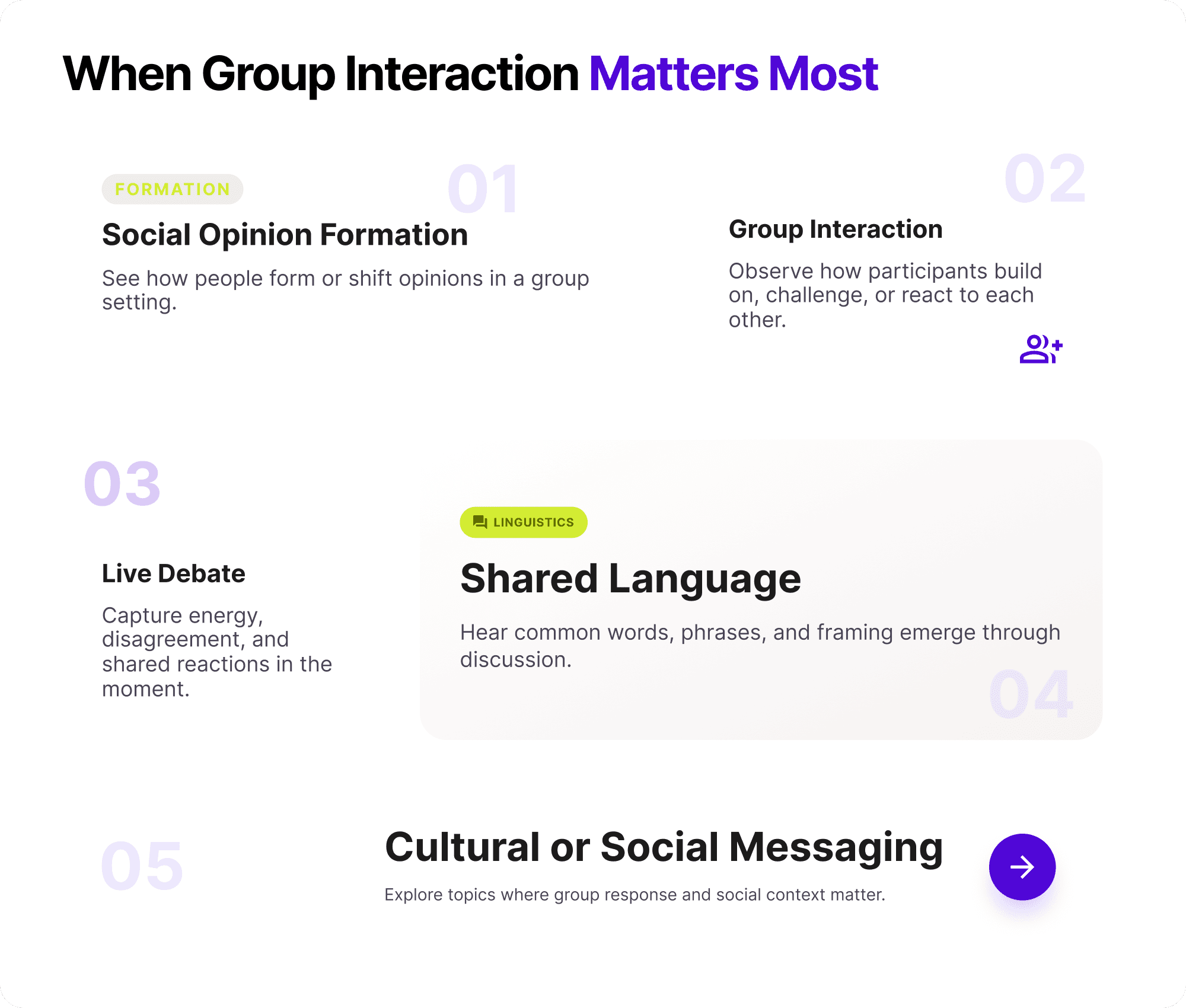
They are often the better option when:
you want to observe how opinions form in a social setting
group interaction is part of the research question
live debate and shared reactions are useful
the study benefits from participants reacting to one another
you want to hear common language emerge through discussion
For example, a team exploring how people talk about a social category, react to cultural messaging, or respond to live debate around a concept may get more value from a group setting than from individual interviews.
That is because focus groups are not only about what people say. They are also about what happens when they say it around others.
When AI Moderated Interviews Are the Better Choice
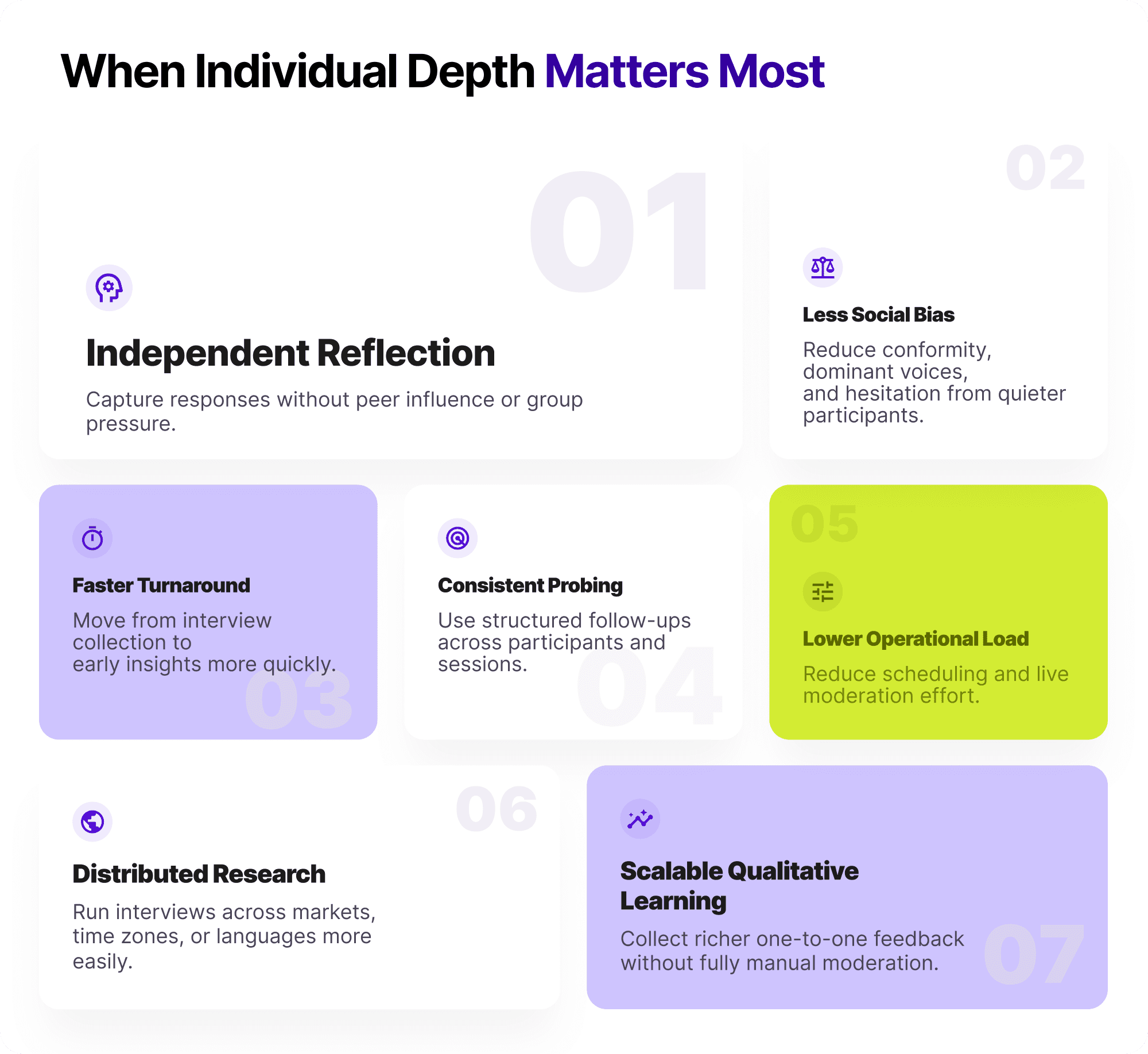
AI-moderated interviews are often the stronger choice when:
you want less socially influenced feedback
independent reflection matters more than group interaction
the team needs faster turnaround
the study needs more consistency across participants
operational complexity is a constraint
interviews need to run across time zones or languages
the goal is to scale qualitative learning without fully manual moderation
This makes them especially useful when researchers need exploratory input that is still personal, open-ended, and probe-friendly, but easier to execute at greater scale.
For many teams, that can make AI moderation a better fit than focus groups when the main goal is individual depth rather than shared discussion.
What Neither Method Solves on Its Own
Both methods can be useful, but neither guarantees good research on its own.
Strong outcomes still depend on:
clear research objectives
good question framing
strong stimulus or concept design where relevant
thoughtful interpretation
choosing the method based on the real research goal
A focus group will not automatically produce useful insight just because multiple people are talking. And AI moderation will not automatically produce strong qualitative learning if the underlying questions are weak or the research objective is unclear.
So the method matters, but design and interpretation matter just as much.
How to Choose the Right Method
If your team is deciding between these methods, a few questions can help.
Does group interaction matter?
If the research depends on discussion, shared language, peer reaction, or live debate, focus groups are likely the better fit.
Does independent reflection matter more?
If you want individual responses with less social influence, interviews are usually the better choice.
Are speed and scale priorities?
If the team needs faster turnaround or more interviews with less operational weight, AI moderation may be the more practical option.
Is the topic sensitive?
Some topics may not work well in a group. Participants may hold back, conform, or avoid saying what they really think. Individual interviews are often stronger in those cases.
Is operational complexity a constraint?
If coordination, scheduling, or repeated live moderation is slowing the work down, AI moderation can help make the workflow more manageable.
The right answer comes from the research goal, not from the novelty of the method.
How Decode by Entropik Helps
For teams comparing focus groups with interview-based approaches, Decode AI Moderator is most useful when the goal is individual qualitative depth without the operational burden of live moderation.
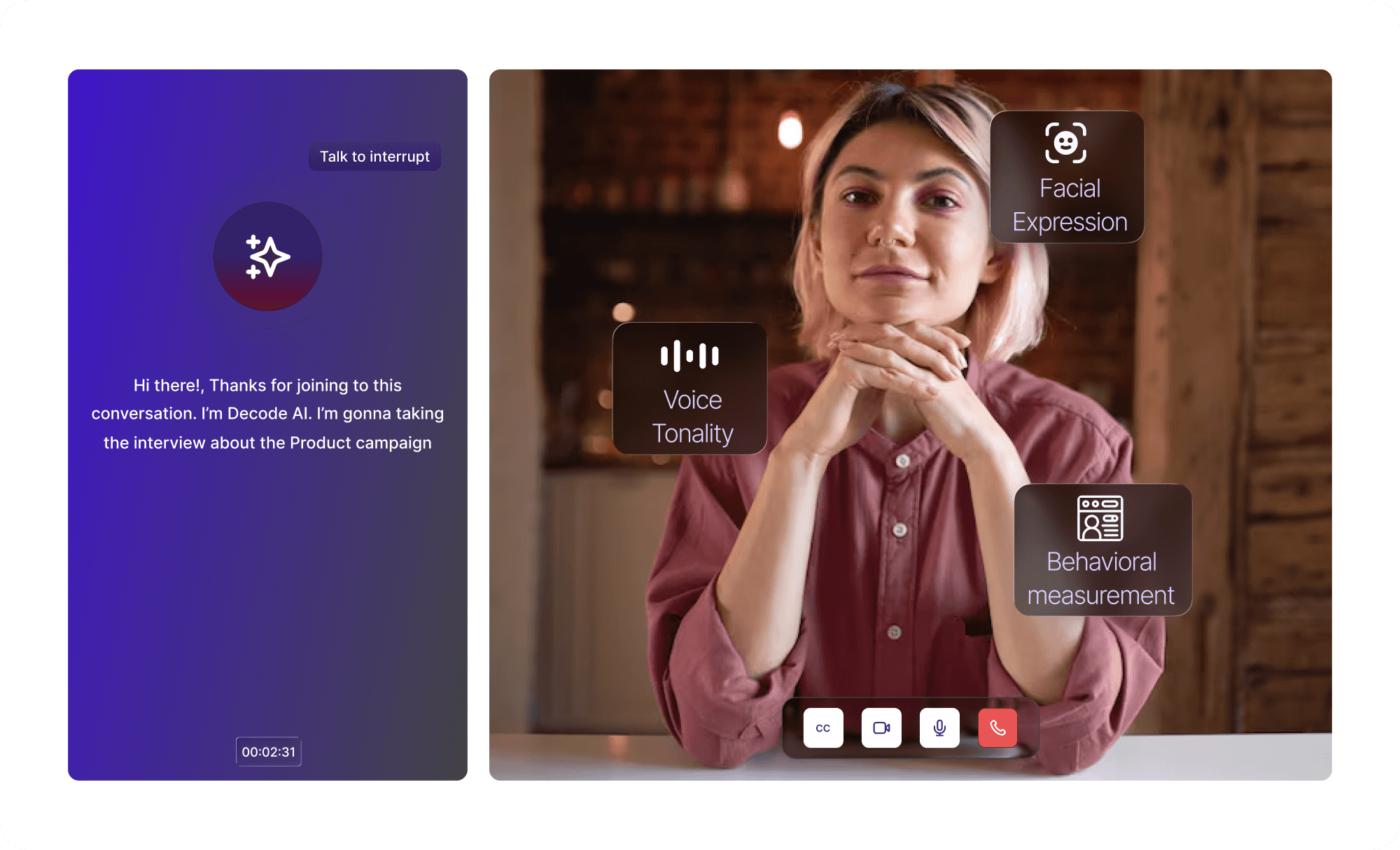
With Decode AI Moderator, teams can:
run adaptive one-to-one interviews at scale
use follow-up questions based on participant responses
reduce peer influence by capturing independent reactions rather than group-shaped responses
capture emotional and behavioral signals alongside verbal feedback
support more consistent interview execution across sessions
run interviews across distributed markets and languages
get preliminary insights as interviews complete
That makes Decode especially useful when a team does not need group interaction, but does need richer individual feedback, faster turnaround, and a more scalable interview workflow.
Final Thoughts
Focus groups and AI-moderated interviews solve different research problems.
Focus groups are useful when the interaction between participants is part of what you need to understand. AI-moderated interviews are useful when you need individual qualitative depth, less social influence, and a more scalable workflow.
So the best method depends on the research goal.
If your team needs group dynamics, live debate, and socially shaped reactions, focus groups may be the right fit. If your team needs speed, consistency, and more individually grounded responses, AI-moderated interviews may be the better choice.
The strongest research teams are not loyal to one method. They choose the method that best matches the kind of insight they need.
Frequently asked questions
1. What is the difference between AI-moderated interviews and focus groups?
AI-moderated interviews are typically one-on-one conversations guided by AI, while focus groups involve multiple participants discussing together, often with a live human moderator.
2. When should you use AI-moderated interviews over focus groups?
AI-moderated interviews work well for scaling individual, unbiased feedback quickly, while focus groups are better when group dynamics and discussion can surface richer, socially-influenced insights.
3. What are the cost and speed differences between the two methods?
AI-moderated interviews are generally faster and cheaper to scale since they don't require scheduling groups or live moderators, while focus groups require more coordination and cost.
4. Can AI-moderated interviews and focus groups be used together in one study?
Yes, many research plans use AI-moderated interviews to gather broad, scalable individual feedback and follow up with focus groups to explore key themes in group discussion.
5. Do participants respond differently to AI moderators versus human moderators?
Some studies suggest participants may share more candidly with AI due to reduced social pressure, though this can vary by topic sensitivity and individual comfort with AI.
Related Topic: