Skipping UX testing shifts the cost of catching design issues from the cheap, early design phase to after launch, where fixing the same error can cost far more in rework, lost users, and damaged reputation. Since roughly half of development time is often avoidable rework, and poor UX drives users away after one bad experience, testing upfront costs far less.
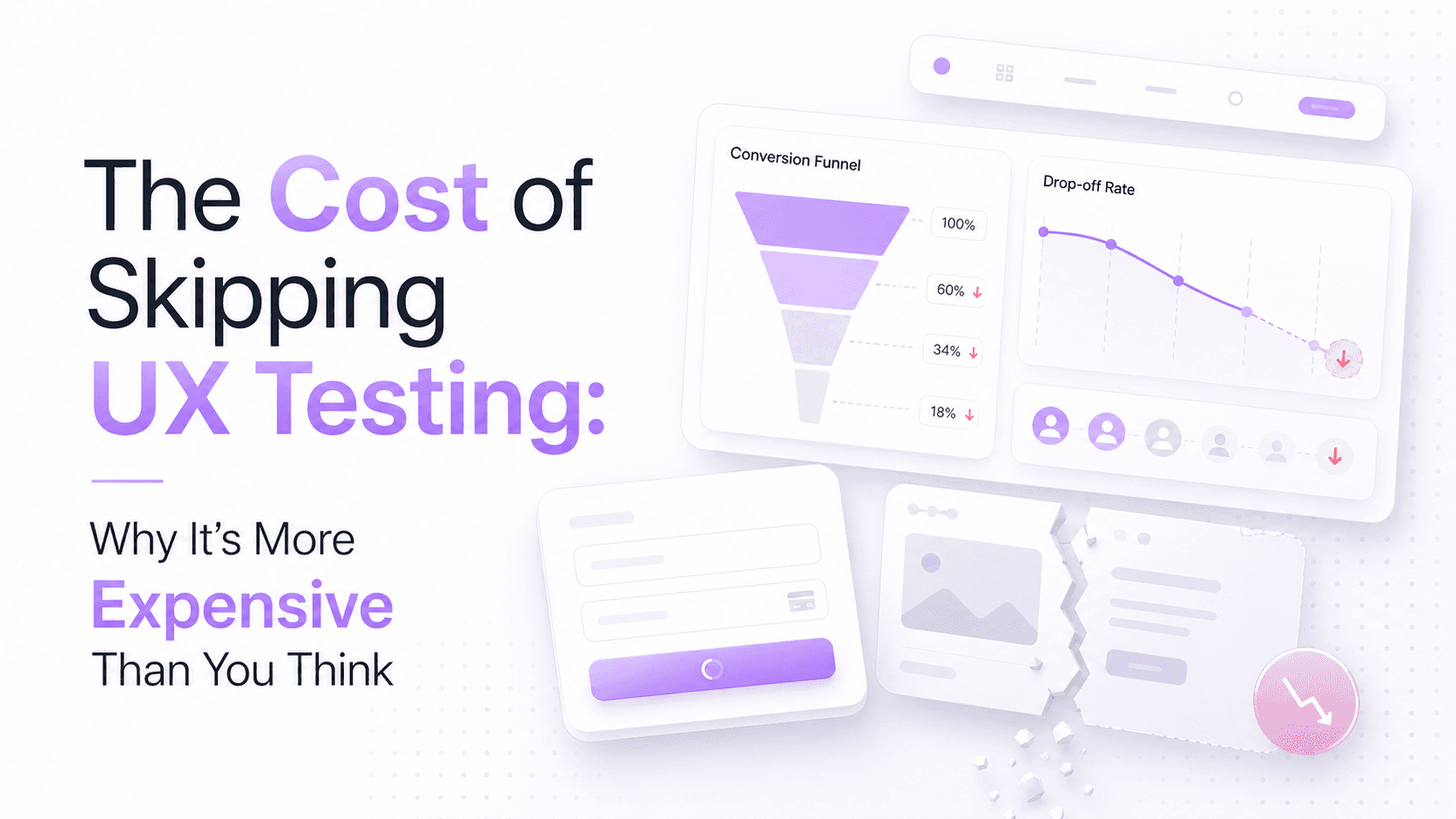
The Shortcut That Costs More in the Long Run
Skipping UX testing can feel like a practical decision. Teams save time, reduce upfront effort, and move faster toward launch.
But that saving is often temporary.
What gets avoided early usually shows up later as rework, delays, lost conversions, support burden, and damaged trust. In digital products, where experience directly affects retention, revenue, and brand perception, skipping UX testing is not a shortcut. It is a business risk.
The Illusion of Saving Time and Money
A common scenario looks like this: a team spends weeks building a feature with multiple stakeholders, developers, and budget behind it. Yet a lightweight round of usability testing with a small group of users could have exposed key issues before development moved too far.
Still, many teams skip testing because of:
tight deadlines
budget pressure
confidence in internal assumptions
pressure to ship quickly
The irony is that companies often spend heavily building features users do not actually need or do not understand.
The Real Cost of Skipping UX Testing
1. Wasted development time and budget
Without UX testing, teams build on assumptions rather than evidence.
That leads to:
features that do not solve the right problems
misaligned product decisions
expensive redesigns
avoidable post-launch fixes
The later these issues are found, the more expensive they become.
2. Poor user experience means lost customers
Users are far less tolerant of friction than they used to be. When navigation feels unclear or key actions are confusing, they leave.
When user experience testing is skipped:
journeys become harder to complete
expectations break down
trust drops faster
The result is often lost revenue, lost confidence, and lower return usage.
3. Lower conversions and revenue leakage
Experience quality directly affects business outcomes.
When users struggle:
they do not complete purchases
they do not sign up
they do not move forward
Poor usability creates quiet leaks in the funnel. Even small usability issues can create meaningful drop-offs at high-intent moments.
4. Higher customer support costs
Products that are harder to use create more support demand.
Skipping usability testing often leads to:
more support tickets
more time spent explaining basic flows
higher operational cost
more pressure on service teams
Instead of scaling growth, teams spend energy fixing problems that could have been prevented earlier.
5. Wasted marketing spend
A product can attract traffic and still underperform if the experience does not hold up after the click.
That creates:
high acquisition cost
weak conversion
poor return on spend
In many cases, poor UX is the hidden reason marketing underperforms.
6. Damage to brand perception
Friction does not stay isolated inside the interface. Users attach that frustration to the brand itself.
When the experience feels confusing, slow, or unclear:
trust weakens
confidence drops
return likelihood falls
Most dissatisfied users do not complain. They simply leave.
A Simple Scenario
A company launches a new app feature without UX testing.
What they expect
increased engagement
positive feedback
measurable growth
What actually happens
users do not understand the feature
engagement drops
support tickets rise
the team reworks the feature after launch
more budget gets spent
roadmap progress slows
In many cases, this cycle could have been prevented through early prototype testing or lightweight validation before rollout.
Why Teams Still Skip UX Testing
Even with the risks, teams still avoid UX testing because they say:
“We do not have time”
“We already know our users”
“We will fix it later”
But skipping testing does not remove the cost. It just delays it.
UX Testing as a Business Investment
Good UX testing is not only about usability. It is about reducing uncertainty, lowering rework, and improving business performance.
This is where UX ROI becomes important. Testing early helps teams avoid waste, improve outcomes, and make better decisions before launch. That makes it one of the highest-return activities in product development.
Seen this way, testing is not a research luxury. It is risk reduction.
It is also one of the clearest usability testing benefits for teams under pressure: catching expensive mistakes before they spread through product, engineering, support, and marketing.
How to Avoid These Costs
To reduce these risks, brands should:
test early, not only after launch
validate assumptions with real users
combine qualitative and behavioural signals
keep improving based on evidence
This is also where broader UX research plays an important role. Testing does not need to stand alone. It works best when teams use it alongside ongoing research, observation, and behavioural insight.
The earlier teams test, the cheaper and more effective the fixes usually are.
How Decode by Entropik Helps
Modern user experience testing can go beyond surveys and moderated sessions alone.
Decode by Entropik helps teams:
measure real attention through eye tracking
understand emotional response through facial coding
analyze behaviour across digital experiences
identify friction points before launch
test prototypes, journeys, and creatives at scale
This gives teams a more evidence-based way to improve experiences before costly issues appear in the market.
Final Thought
Skipping UX testing is not a cost-saving decision. It is a cost-shifting mistake.
Teams either invest early in understanding users, or they pay later through rework, churn, lost revenue, and slower growth.
In competitive markets, the brands that win are not always the fastest to launch. They are the ones that get the experience right.
Frequently asked questions
1. What are the hidden costs of skipping UX testing?
Hidden costs include expensive post-launch fixes, lost conversions from usability issues, increased customer support burden, and damage to brand reputation from a poor user experience.
2. How much more expensive is it to fix usability issues after launch versus before?
Industry estimates suggest fixing usability issues after development is significantly more costly often cited as many times more expensive than catching them during design or prototyping.
3. What business metrics are affected by skipping UX testing?
Metrics like conversion rate, customer retention, support ticket volume, and overall customer satisfaction can all suffer when usability issues go unaddressed.
4. Can small companies afford to skip UX testing to save time and budget?
While tempting for resource-constrained teams, even lightweight, low-cost usability testing early on can prevent much larger costs from usability issues discovered later.
5. What is the most cost-effective way to incorporate UX testing into a tight budget?
Running small, iterative tests with 5 participants at key milestones, using unmoderated remote testing tools, offers a cost-effective way to catch major issues without a large budget.
Related Topic: