NPS passives rate their experience a 7 or 8, neither actively frustrated nor genuinely delighted, meaning the score alone reveals little about what's holding them back. Since passives are often the easiest group to move toward becoming promoters, brands that segment and analyze this middle group more closely can uncover disengagement patterns a single NPS number hides.

The Hidden Risk Behind “It’s Fine”
Most brands celebrate high scores and panic over negative feedback. But the most dangerous signal often sits quietly in the middle: neutral feedback.
Customers who say “it was okay” or give a 7 or 8 in Net Promoter Score are usually treated as low-risk users. On paper, they are not a problem. In reality, they are often the biggest blind spot in the entire feedback system.
That is because these middle-ground responses usually point to a lack of conviction, not a lack of complaints. And when brands ignore that difference, they miss one of the clearest opportunities for growth.
Understanding Neutral Feedback Through NPS
The Net Promoter Score framework divides customers into three groups:
Promoters (9–10): loyal advocates
Passives (7–8): satisfied but not impressed
Detractors (0–6): unhappy and more likely to churn
This is where NPS passives matter. They do not directly pull the score down the way detractors do, but they also do not contribute to advocacy, referrals, or meaningful momentum.
That is why brands should stop treating passives as background noise. In many cases, NPS passives are customers who found the experience acceptable, but not distinctive enough to remember, recommend, or repeat with enthusiasm.
You can also think of them as the quiet middle: not upset enough to complain, not impressed enough to care.
Why Neutral Feedback Is More Dangerous Than Negative Feedback
1. Indifference is harder to detect than dissatisfaction
Detractors complain. Passives usually do not.
People who give neutral feedback often:
do not raise issues directly
do not engage deeply
do not care enough to explain what felt average
This creates a dangerous illusion. Silence can look like satisfaction when it is really disengagement.
2. Neutral customers do not drive growth
Promoters amplify a brand. Detractors can damage it. Passives do neither.
That means:
no word of mouth
no meaningful advocacy
no emotional pull toward the brand
The brand does not become hated. It becomes forgettable.
3. They are easier for competitors to win
Most passive customers are not deeply loyal. They are not strongly attached, and they are more likely to switch when a better offer, better experience, or stronger message appears.
That makes them highly vulnerable in competitive categories.
4. NPS alone hides the real issue
One of the biggest limitations of NPS is that it emphasizes the extremes. It does not tell brands enough about why the middle feels uncommitted.
A company can have a decent score and still have a large base of indifferent users. That is a growth problem hidden behind a respectable dashboard.
Why Customers Give Neutral Feedback
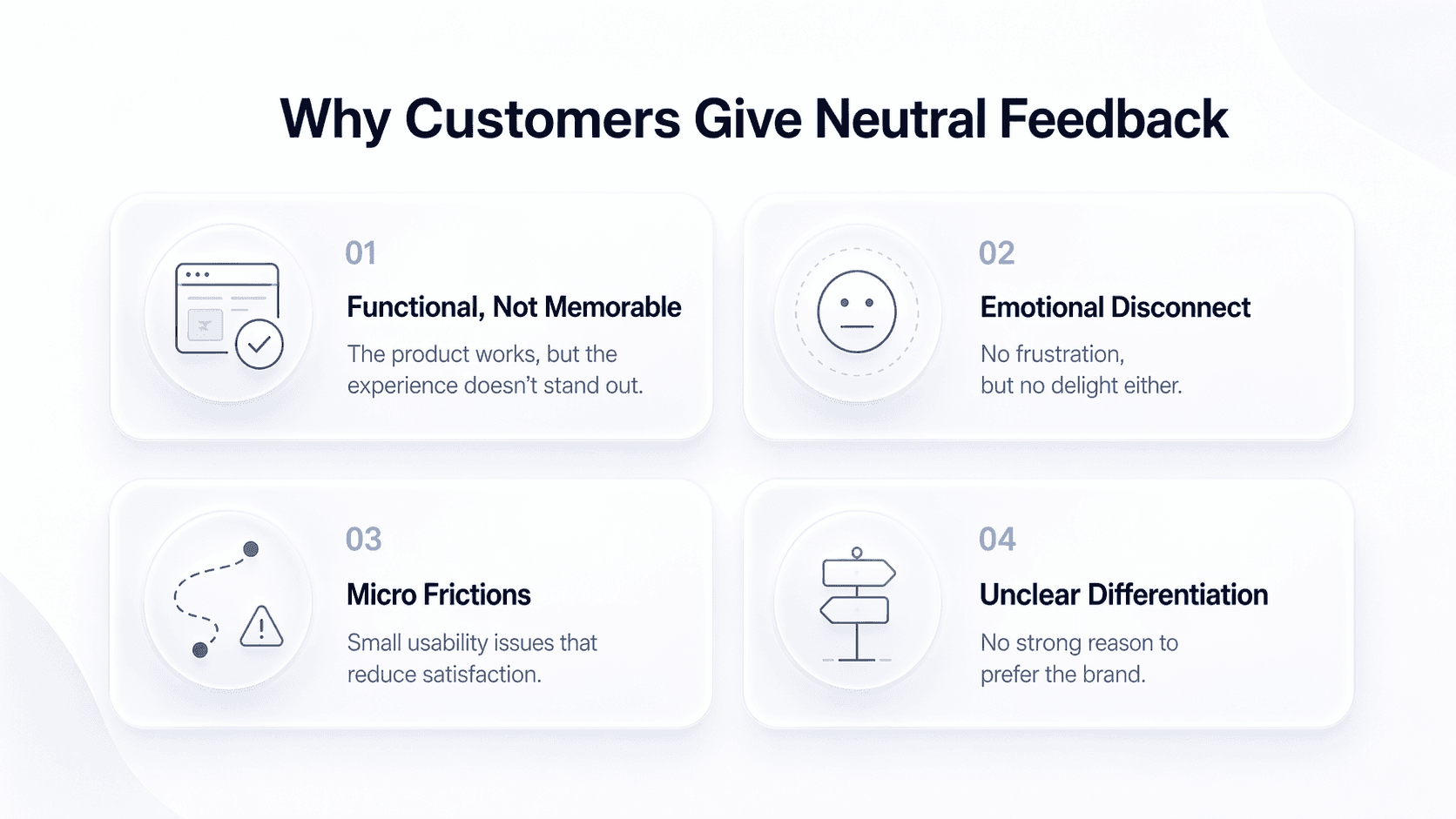
Neutral feedback is rarely random. It usually points to one of four issues:
1. The experience was functional, not memorable
The product worked. The experience did not stand out.
2. There was emotional disconnect
The customer was not frustrated, but they were not delighted either.
3. Small frictions added up
Minor usability issues, delays, or unclear moments may not trigger complaints, but they still reduce satisfaction.
4. The value did not feel differentiated
Customers did not see a strong reason to prefer the brand over another option.
The Real Problem: Neutral Feedback Lacks Depth
A score of 7 or 8 tells you very little on its own.
Without deeper context, brands cannot answer:
What exactly felt average?
Where did the experience break down?
What would have made it better?
What would move this customer toward advocacy?
This is where stronger customer feedback analysis becomes critical. A score alone does not explain hesitation, indifference, or missed moments of value.
How Brands Should Rethink Neutral Feedback
1. Treat passives as a priority segment
Instead of ignoring them, brands should segment them, track their behaviour over time, and identify patterns in disengagement.
This is especially important because net promoter score passives are often the easiest group to move upward with the right improvements.
2. Go beyond scores and capture context
Every survey should go beyond the number.
Brands need to understand:
where the user hesitated
what they noticed first
what confused them
where the journey felt average rather than effortless
3. Map neutral feedback to the customer journey
Neutral feedback often appears at specific touchpoints:
onboarding friction
checkout complexity
weak content clarity
moments of uncertainty or delay
Mapping those patterns helps teams identify where the experience is falling short.
4. Look for emotional gaps, not just functional gaps
Most brands optimize for usability. Fewer optimize for emotional response.
That is where customer sentiment analysis adds value. It helps brands understand whether an experience merely worked, or whether it created confidence, trust, and positive momentum.
How to Turn Neutral Feedback into Growth
To convert passives into promoters, brands need to:
remove friction points
improve clarity and usability
personalize experiences
strengthen emotional engagement
Even small improvements can shift the customer response from “it’s fine” to “I would recommend this.”
This is not just about lifting a score. It is about improving memory, differentiation, and long-term customer loyalty.
The Missing Layer: Understanding Behaviour and Emotion
Traditional feedback tools tell you what users said. They do not always tell you:
what users actually experienced
what they paid attention to
what they felt in the moment
what reduced confidence before the score was submitted
That missing layer matters because passives are often created by subtle signals, not dramatic failures.
This is also why teams should not rely only on passive NPS labels inside dashboards. Labels describe the category, but they do not explain the cause.
How Decode Can Help with Neutral Feedback
Platforms like Decode by Entropik can help brands move beyond surface-level survey responses by showing what users experienced before they submitted a passive score.
With Decode, brands can:
capture real behaviour and engagement patterns
measure attention and emotional response during experiences
identify hidden friction points in UX and content
understand why users felt neutral instead of satisfied
This helps teams see what drives disengagement, what weakens recall, and what prevents progress from passive to promoter.
For brands trying to strengthen customer loyalty, that deeper layer of understanding matters.
Final Thought
Negative feedback is loud. Positive feedback is rewarding. But neutral feedback is often where growth is lost.
Because in competitive markets, customers who feel nothing usually do nothing.
And brands that ignore NPS passives risk becoming easy to leave and hard to remember.
Frequently asked questions
1. What are NPS passives?
NPS passives are respondents who give a score of 7 or 8 on the Net Promoter Score scale, indicating satisfaction without strong enthusiasm or loyalty.
2. Why are NPS passives considered risky for brands?
Passives are satisfied but not enthusiastic, making them vulnerable to switching to a competitor if a better option or offer comes along.
3. How should brands treat passives differently from promoters and detractors?
Brands should proactively investigate what would move passives to becoming promoters, rather than ignoring them since they're not actively complaining like detractors.
4. What follow-up questions help understand passive feedback?
Asking passives directly what would make them rate their experience higher can reveal specific, actionable improvements to increase their loyalty.
5. Can a high proportion of passives distort overall NPS interpretation?
Yes, a large passive segment can mask underlying risk, since NPS calculations exclude passives entirely, potentially giving a falsely positive impression of loyalty.
Related Topic: