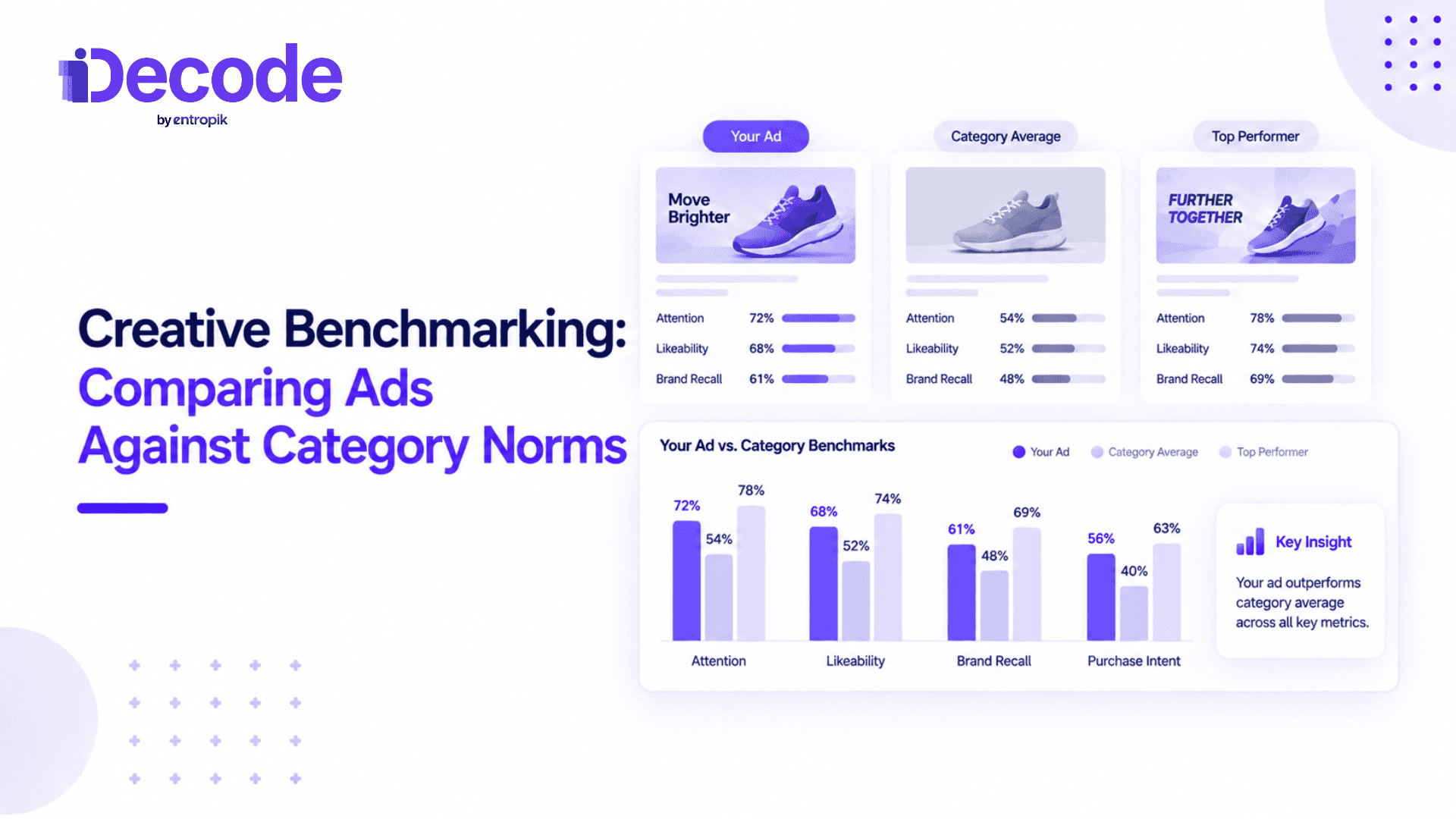
Creative benchmarking is the process of comparing an ad's performance or effectiveness against reference points such as category norms, overall industry norms, or a brand's own historical results. It typically uses percentile scoring to show how a creative ranks relative to a normative database, helping teams judge whether an ad is genuinely competitive rather than just an improvement over their own average.
Summary:
|
A new ad scores better than last quarter's. The team celebrates, the media plan goes live, and results come in flat. What went wrong? Often, nothing about the test itself. The ad genuinely improved on the brand's own history. It just was not good enough to stand out against competitors.
That is the gap creative benchmarking is designed to close. Instead of asking "is this better than before?", it asks "how does this compare with what good looks like in our category right now?"
This guide explains what creative benchmarking is, why category norms matter, the main types of benchmarks, how percentile scoring works, and how to build a benchmarking process that supports real media decisions.
What Creative Benchmarking Means
Creative benchmarking is the process of comparing an ad's performance or effectiveness against a reference point. That reference can be a product category, the wider industry, or a brand's own historical results.
The output is typically a percentile score or rank that shows where a creative sits relative to a normative database. A score in the 80th percentile, for example, means the ad outperformed 80% of the ads it was compared against on that measure.
Ad benchmarking can run at two points:
Pre-launch, to screen creative before media budget is committed
Post-launch, to put live campaign results in context
It is closely tied to creative effectiveness, since a benchmark is only as useful as the effectiveness measures it compares.
Why Category Norms Matter More Than Internal Comparisons
Internal Progress Can Create False Confidence
Comparing only against your own history tells you whether you are improving. It does not tell you whether you are competitive. A brand whose previous ads were weak can beat its own average comfortably and still sit in the bottom half of its category.
Category Norms Show the Competitive Picture
Benchmarked against category norms, advertising teams can see whether an ad is winning within its specific competitive set. That is the comparison that matters to consumers, who see your ad alongside rivals, not alongside your last campaign. The same logic underpins broader competitor benchmarking in consumer research.
Creative Is Often the Biggest Variable
Competitive context matters most because creative quality drives so much of the outcome. Nielsen found that creative quality contributes as much to in-market success as all other factors combined, and when creative is strong it can account for up to 80% of success on TV and 89% in digital.
The gap between strong and average creative shows up at the business level too. McKinsey's Award Creativity Score research found that 76% of companies in the top quartile had above-average organic revenue growth and 70% had above-average total return to shareholders. Knowing where your creative sits in that distribution is the point of benchmarking.
The reasons some ads rise to the top are explored in this look at the psychology of high-performing creatives.
Creative Benchmarking vs Performance Benchmarking
Creative (effectiveness) benchmarking | Performance benchmarking | |
What it measures | Persuasion, brand impact, attention, emotion | Channel metrics such as CTR, CPA, conversion rate |
Typical data source | Aggregated results from controlled testing | Campaign delivery data |
Timing | Pre-launch or post-launch | Post-launch |
Question answered | Will this ad shift how people think and feel about the brand? | Is this ad delivering efficiently in its channel? |
These two are often blurred, but they measure different things. A strong CTR relative to a platform average does not confirm that an ad is shifting brand consideration against competitors. Nielsen's analysis of 200 online campaigns found a correlation of negative 0.07 between click-through rate and ROI, meaning clicks were in no way predictive of overall effectiveness.
Effectiveness benchmarking also needs cleaner data than delivery metrics provide. Kellogg School of Management research on a large set of Facebook ad experiments found that non-experimental methods produced median lift errors of 115%, 107%, and 62% across funnel stages, compared with true experimental lifts of 28%, 19%, and 6%. That is why effectiveness norms are usually built from controlled testing rather than campaign reporting.
Both views are useful. Performance benchmarks tell you how efficiently a campaign runs. Effectiveness benchmarks tell you whether the creative is worth running in the first place, which is the core question in ad testing.
Types of Creative Benchmarks
Each benchmark type answers a different comparison question. Most teams need more than one.
1. Category Norms
Category norms are benchmarks built from ads within a specific product or industry category, such as snacks, banking, or telecom. They show how an ad performs against the competitive set it will actually run alongside.
Category norms can sometimes diverge from broader overall norms. An ad might sit in the 60th percentile overall but the 85th within a category where creative standards are generally lower. When that happens, flag it clearly to stakeholders so the result is not misread.
2. Overall or Cross-Category Norms
Overall norms are industry benchmarks advertising researchers build from a much larger pool of ads across all categories. Scale is their main strength. Kantar's Link database, for example, spans more than 200,000 ads analyzed over 30 years, and its top-rated ads were at least twice as likely to drive sales as an average ad.
The trade-off is specificity. Larger pools improve statistical reliability but may be less relevant to a brand's exact competitive set.
3. Within-Brand Norms
Within-brand norms compare a new creative against the brand's own historical results. They are useful for tracking whether creative quality is improving over time and for spotting creative fatigue when newer executions start underperforming older ones.
On their own, though, within-brand norms are incomplete. They cannot show whether the brand is competitive against its category.
How Percentile Scoring Works
Percentile scoring ranks a creative's result against the full distribution of scores in the normative database. If an ad scores higher than 72% of comparable ads, it sits at the 72nd percentile. Scoring ads by percentile makes results easy to compare across metrics and campaigns.
Three factors determine whether those percentiles can be trusted.
1. Norms Must Be Current
Creative styles, formats, and audience expectations change. A normative database that has not been refreshed can misrepresent what "good" looks like today. Media shifts make this especially important. The IAB projects digital video will exceed 60% of total TV and video ad spend in 2026 for the first time, which changes the kind of creative audiences see most.
2. Norms Must Match the Format
Video and static creative should be benchmarked against format-specific norms, not a single blended baseline. A static banner and a 30-second video are processed differently, hold attention differently, and should not be scored on the same curve.
3. Norms Must Be Statistically Sound
A benchmark built from a thin sample of ads can shift dramatically with a few additions. Sound measurement design matters, and the principles in this guide to validity and reliability in research apply directly to building dependable norms.
How to Run a Creative Benchmarking Process
A simple three-step framework keeps creative benchmarking focused on decisions rather than scores.
Step 1: Decide what is being benchmarked.
Choose between effectiveness measures, such as persuasion, brand impact, attention, and emotion, or performance measures, such as CTR, CPA, and conversion rate. Mixing the two in one scorecard leads to confusion.
Step 2: Choose the comparison set.
Match the norm to the decision. Use category norms to judge competitiveness, overall norms for broader context, and within-brand norms to track progress. For a campaign going head to head with rivals, category norms should lead.
Step 3: Score and check for discrepancies.
Score the creative against the chosen norm, then compare category and overall results. If they diverge sharply, investigate before acting. The ad may be strong for its category but still weak in absolute terms, or the reverse.
Where scores are weak, message testing can identify whether the problem lies in what the ad says rather than how it looks.
Teams with limited budgets can also start with these low-cost creative tests before moving to full benchmarking.
Common Mistakes in Creative Benchmarking
Relying on outdated norms. A database that no longer reflects current creative styles or audience expectations will reward yesterday's standards.
Mixing performance and effectiveness metrics. Comparing CTR directly against effectiveness benchmarks mixes two different questions and produces misleading conclusions.
Using one baseline for every format. Holding video and static creative to the same benchmark hides real differences in how each format performs.
Benchmarking only against yourself. Within-brand improvement is encouraging, but it says nothing about competitive position.
Ignoring category and overall discrepancies. When the two disagree, acting on only one can lead to the wrong decision.
Current industry context helps avoid these traps. The State of Creative Testing 2026 report outlines how attention benchmarks are being used today.
When comparing ad creative testing platforms, check how often each refreshes its norms and whether it offers category-level and format-specific benchmarks.
Benchmarking Creative Before Media Spend Is Committed
Benchmarking after launch tells you how an ad compared. Benchmarking before launch lets you act on that comparison while there is still time to change the creative or the plan.
Decode's Predictive Creative AI scores creative against category norms before it goes into paid media, giving teams a percentile view of competitiveness at the draft stage.
It builds on the approach described in AI creative insights for predicting performance before media spend.
The underlying signals come from how real viewers respond. Facial emotion AI captures emotional reactions moment by moment.
The methods behind it are explained in this guide to facial coding in marketing.
Attention measurement adds a view of how well each creative holds focus. Together, these feed a pre-launch effectiveness score that can be benchmarked against category and format norms.
For teams running high-volume programs, AI creative testing makes this practical across many variants.
This guide to AI creative testing for ad performance shows how the workflow fits into campaign planning.
The cost case is real as well. One consumer brand cut creative testing costs by 70% using emotion AI, making pre-launch benchmarking a routine step rather than an occasional one.
With benchmarking and diagnostics in one place, teams get creative performance insights that connect directly to media decisions.
Decode's approach to testing ads across formats shows how this works for video, static, and display creative.
Frequently Asked Questions
1. What is the difference between creative benchmarking and performance benchmarking?
Creative benchmarking measures effectiveness, such as persuasion, attention, and brand impact, against norms. Performance benchmarking compares channel metrics like CTR and CPA against platform or industry averages.
2. How often should category norms be updated?
Regularly enough to reflect current creative styles and formats. Many teams review norms at least annually, and more often in fast-moving categories or channels.
3. Can you benchmark a video ad against a static ad using the same norms?
No. Video and static creative are processed differently and should be scored against format-specific benchmarks.
4. What is percentile scoring in ad testing?
It ranks an ad's result against the distribution of results in a normative database. An ad at the 75th percentile outperformed 75% of comparable ads on that measure.
5. How much data is needed to build a reliable category benchmark?
Enough ads to produce a stable distribution for that category and format. Thin databases can shift sharply with a few new entries, so check the size and freshness of any norm before relying on it.
6. Should you compare a new ad against your own past ads or against the category?
Both, for different reasons. Within-brand comparisons track progress. Category comparisons show whether the ad is competitive. For media decisions, category norms should carry more weight.
7. Can creative be benchmarked before it launches?
Yes. Pre-launch testing using attention and emotion measurement, combined with predictive scoring, can place creative against category norms before any media is bought.
Know Where Your Creative Really Stands
Improving on last quarter is a good sign. Knowing whether an ad can win in its category is what protects the media budget. Creative benchmarking done well uses the right comparison set, current format-specific norms, and effectiveness measures that reflect real viewer response.
Decode by Entropik combines predictive creative scoring with facial emotion AI and attention measurement, so teams can benchmark creative against category norms before spend is committed.