The best Qualtrics alternatives depend on your reason for leaving: an enterprise CX platform for large feedback programs, a broad survey suite with published pricing, a self-serve tool for quick surveys, clinical data capture for academic research, or automated advanced quant. Decode is best when decisions depend on how consumers react, measuring emotion and attention alongside their answers.

If you run enterprise-wide customer experience programs, Medallia is the closest like-for-like replacement. For a broad survey and research suite with lower published entry pricing, look at QuestionPro. For fast self-serve surveys, SurveyMonkey or Alchemer. For academic and clinical work, REDCap.
And if your decisions depend on how consumers react, not only what they report, that’s where Decode comes in. It measures emotion and attention on real people in the same study as their answers.
Not sure which fits your team? Talk to our research team and bring the question you’re trying to answer.
Qualtrics alternatives compared at a glance
Eight tools, each strong at something different. Starting prices are as of October 2026, taken from each vendor’s own pricing page.
Tool | Best for | Starting price | Key strength | Main limitation |
|---|---|---|---|---|
Decode | Consumer and UX research that measures emotion and attention | Free plan ($0, 100 responses a month); Enterprise quote-based | Facial coding, eye tracking and voice emotion on real people, in the same study as their answers | Focused on research, not CX or employee experience program management |
Medallia | Enterprise CX programs at scale | Quote only | Omnichannel voice of customer with text and speech analytics | Same enterprise commitment and implementation load as Qualtrics |
QuestionPro | Broad research suite, published entry pricing | Free plan; Advanced $99 per user a month, billed annually | Survey suite with conjoint, MaxDiff and TURF | Conjoint and MaxDiff sit on the quote-only Research Suite |
Alchemer | Flexible surveys and workflow automation | $55 per user a month, or $315 per user a year billed annually | Deep logic and routing into CRM and support tools | Not a full experience management suite |
SurveyMonkey | Fast self-serve surveys | Free plan; team plans from $30 per user a month, billed annually (3-seat minimum) | Easiest to adopt, with templates and AI survey building | Limited research method depth |
REDCap | Academic and clinical research | No license cost for REDCap Consortium institutions | Built for regulated clinical and academic data capture | Only available through a member institution |
quantilope | Automated advanced quant | From $2,300 a month (Business, 3 users); higher tiers quoted | Conjoint, MaxDiff, TURF and implicit methods in one workflow | Quant-first; qual and facial emotion only via inColor video |
Sprig | In-product feedback for software teams | Quote only (self-serve plans removed in August 2026) | Surveys triggered by in-app user events | Enterprise-only; strongest on digital product research |
Book a demo of Decode to see emotion and attention measured on a live study.
Before you switch: which “alternatives” Qualtrics now owns
Several tools that still appear on Qualtrics alternatives lists now belong to Qualtrics, or no longer exist. If price or contract terms are why you’re leaving, check ownership before you shortlist.
Product | Status in October 2026 | Since |
|---|---|---|
Forsta (Press Ganey Forsta) | Owned by Qualtrics, through its $6.75 billion acquisition | Completed May 2026 |
InMoment | Owned by Qualtrics, through the Press Ganey Forsta deal | May 2026 |
Delighted | Shut down; users steered to Qualtrics CX | June 30, 2026 |
Clarabridge | Part of Qualtrics | 2021 |
None of this makes those products bad. It means that switching to them may not change your vendor, your renewal conversation or your roadmap.
Why teams look for Qualtrics alternatives
Five reasons come up again and again in reviews and buyer conversations.
The renewal outgrows the usage. Enterprise programs are quote-based, and buyers on G2 and Reddit describe rising renewals and longer terms. Many teams use a fraction of the suite they pay for.
The platform needs a specialist. A full instance often needs a dedicated admin. Smaller insights teams feel that overhead most.
Surveys only capture what people say. Teams testing ads, packaging and digital experiences need to know what people noticed and how they reacted. Qual-heavy teams want AI-moderated interviews at scale.
Synthetic versus real respondents. Qualtrics launched synthetic consumer panels in March 2026. Synthetic reads are useful for early ideas, but many teams want final decisions measured on real people.
Lost academic access. Graduate students and researchers lose their university license when they move on, and need a tool they can access themselves.
The gap between what people say and what they do is well documented. Harvard Business Review reported that in one survey, 65% of consumers said they want to buy purpose-driven brands that advocate sustainability, yet only about 26% actually do. A survey captures the first number. Behavior and reaction explain the second.
How to choose a Qualtrics alternative
Start with scope. Do you need a full experience management suite for CX and employee programs, or a research platform? That one answer removes half of this list.
Then judge each tool on five things:
Method depth. Advanced quant (conjoint, MaxDiff), qual interviews, usability testing, AI-moderated interviews.
Signal layer. What the tool can actually capture about a respondent (see below).
Respondents. Its own panel, your own customers, and whether answers come from real people or synthetic ones.
Total cost. Seats, response caps, modules, implementation and admin time, not just the list price.
Governance. SSO, data residency, and certifications such as SOC 2 and ISO 27001.
The signal layer: say, do, feel
Most comparisons stop at what respondents say. Research decisions often hinge on the other two layers.
Say: stated answers to questions. Every tool here does this.
Do: behavior, such as clicks, task success and time on task.
Feel: non-verbal reaction, measured through facial coding, eye tracking and voice emotion.
Tool | Say | Do | Feel |
|---|---|---|---|
Decode | Yes | Yes: task success, clicks, gaze paths | Yes: facial coding, eye tracking, voice emotion |
Medallia | Yes | Partly: digital behavior analytics | Partly: text and speech sentiment; facial emotion on video feedback (add-on) |
QuestionPro | Yes | Yes: task completion and time on task (QuestionPro UX) | Partly: face-cam emotion recognition in usability tests |
Alchemer | Yes | No | No |
SurveyMonkey | Yes | No | No |
REDCap | Yes | No | No |
quantilope | Yes | No | Partly: implicit association tests; facial emotion on inColor video |
Sprig | Yes | Yes: in-app events and replays | No |
Sentiment read from words is not the same as emotion measured on a face, and a recorded video answer is not the same as a moment-by-moment read of facial coding, eye tracking and voice emotion together. If your decisions turn on reaction (an ad, a pack, a first-time user’s hesitation), the Feel column is the one to check.
See the Feel layer measured on a live study: facial coding, eye tracking and voice emotion, in one session.
The 8 best Qualtrics alternatives
1. Decode by Entropik: best for consumer and UX research that measures emotion and attention
Decode is built for the question surveys struggle with: how people actually react. It measures emotion and attention on real participants, through a standard webcam, in the same study as their answers.
Best for: consumer insights, brand, marketing and UX teams whose decisions depend on reaction, not only stated opinion.
Key features
Consumer Insights for quant and qual, User Research for usability and prototype tests, and AI Creative Insights for creative pre-testing.
AI Moderator for AI-moderated interviews at scale, and Insights Hub as the research repository.
Facial coding (90%+ accuracy, 62 expressions), eye tracking (96% accuracy) and voice emotion, measured in the same session.
AI research agents: describe the problem, and a specialist agent picks the method and drafts the study for your review. Ravi handles brand perception and Gia handles purchase decisions, for example.
103M+ participants in 151 markets through Cint and Dynata, or bring your own. Studies run in 70+ languages.
Pros
The only tool on this list that combines facial coding, eye tracking and voice emotion in one session, alongside the answers.
Agents cut setup time: a plain-language brief becomes a draft study.
Reports in under an hour once fieldwork is in, with feasibility checked within 24 hours.
Good to know
Decode is built for research. It doesn’t run CX case management or employee engagement programs, so teams with those programs often keep a CX platform alongside it.
Enterprise plans are tailored to your research volume, and you can start on the Free plan before talking to sales.
Pricing: a Free plan is published ($0, 100 responses a month). Enterprise is quote-based.
Choose Decode if your decisions depend on how consumers react, not only what they report. Synthetic Audience is available for early creative reads, always labeled synthetic, but final reads run on real people. For the full head-to-head,
See our Decode vs Qualtrics comparison.
2. Medallia: best like-for-like enterprise CX replacement
Medallia is the closest match if you run customer experience programs at enterprise scale.
Best for: large CX teams collecting feedback across digital, contact center and in-location channels.
Key features: omnichannel voice of customer, text and speech analytics, and program management for frontline teams.
Pros: built for scale, strong analytics on unstructured feedback, and mature program tooling.
Cons: the same enterprise commitment, implementation load and quote-based pricing as Qualtrics’ enterprise programs. Research tooling (such as Medallia Video Research Edition) is secondary to its CX programs.
Pricing: quote only.
Choose Medallia if you run a CX program at scale and the problem is fit or service, not budget.
3. QuestionPro: best for a broad research suite with published entry pricing
QuestionPro covers much of the survey methodology Qualtrics is known for, with published entry pricing.
Best for: research teams that want surveys, usability testing and an upgrade path to conjoint and MaxDiff in one vendor.
Key features: a full survey suite, advanced research methods, plus audience and community products.
Pros: published self-serve pricing, a free plan, and a broad method library.
Cons: the interface feels less modern than newer tools. Conjoint and MaxDiff sit on the quote-only Research Suite, not the self-serve plans.
Pricing: free Essentials plan. Advanced is $99 per user a month, billed annually, with 25,000 responses a year.
Choose QuestionPro if you want Qualtrics-style methods and your team is comfortable with a traditional survey tool.
4. Alchemer: best for flexible surveys and workflow automation
Alchemer is the pick when surveys need to trigger actions in other systems.
Best for: mid-market teams routing feedback into CRM, support and marketing tools.
Key features: deep survey logic, workflow routing, and integrations.
Pros: transparent per-seat pricing, and strong logic for complex surveys.
Cons: not a full experience management suite. Reporting and advanced features vary by tier, and the self-serve plans cap user counts.
Pricing: Collaborator is $55 per user a month, or $315 per user a year billed annually. Professional is $165 per user a month. Platform plans are quoted.
Choose Alchemer if your main need is surveys wired into your operating stack.
5. SurveyMonkey: best for fast self-serve surveys
SurveyMonkey is the fastest way for a team to start collecting answers.
Best for: teams that mainly need surveys and want everyone able to build them.
Key features: templates, AI survey building, team plans, and a large integration library.
Pros: the easiest adoption on this list, and a free plan to start.
Cons: limited research method depth. No behavioral or emotion measurement. Team plans carry a three-seat minimum.
Pricing: free Basic plan (10 questions per survey, with a limited number of viewable responses per survey). Individual Advantage is $39 a month billed annually. Team plans start at $30 per user a month, billed annually.
Choose SurveyMonkey if speed and ease matter more than method depth.
6. REDCap: best for academic and clinical research
REDCap is a widely used choice for academic and clinical researchers, if their institution is a consortium member.
Best for: academic, clinical and public health research with regulated data.
Key features: structured data capture, audit trails, longitudinal studies and survey scheduling.
Pros: no license cost to institutions in the REDCap Consortium, and built for compliance-heavy research.
Cons: only available through a member institution. The interface is dated, and it isn’t built for commercial market research.
Pricing: no license cost for non-profit consortium members.
Choose REDCap if you’re an academic or clinical researcher and your institution offers it.
7. quantilope: best for automated advanced quant
quantilope automates the advanced methods that usually need a specialist.
Best for: insights teams running conjoint, MaxDiff and TURF regularly.
Key features: automated advanced methods, implicit association tests, and panel partnerships.
Pros: advanced quant without heavy statistical setup, delivered in one workflow.
Cons: a high entry price, and conjoint and segmentation sit on the quoted Enterprise tier. Quant-first: qual and facial emotion come only through the add-on inColor video tool, with no eye tracking.
Pricing: Business from $2,300 a month for 3 users; Pro and Enterprise are quoted.
Choose quantilope if advanced quant is your core work and you want it automated.
8. Sprig: best for in-product feedback for software teams
Sprig puts surveys inside your product, triggered by what users do.
Best for: digital product teams that want feedback at the moment of use.
Key features: in-product, email and panel surveys, Design, Field and Synthesize AI agents, and session replays and heatmaps.
Pros: feedback tied to real product behavior, with fast setup inside the app.
Cons: enterprise-only since August 2026, with no self-serve plan. Its roots and strongest tooling are in digital product research, and it has no emotion or attention measurement.
Pricing: quote only (Enterprise).
Choose Sprig if you’re a software team and the question lives inside your product.
Qualtrics pricing in 2026: what it actually costs
Qualtrics publishes two entry points, and everything above them is quoted. Its enterprise programs for customer experience, employee experience and research are priced by sales. Pricing as of October 2026.
Plan | Price | What you get |
|---|---|---|
Qualtrics Surveys (free account) | $0 | 1 user, 3 active surveys, 30 questions per survey, 500 total responses |
Strategic Research (self-serve) | $420 a month, billed annually ($5,040 a year) | Unlimited users and surveys, 1,000 responses total shared across all users |
Strategic Research (custom) | Quote | Priced on interactions: survey responses and minutes of video feedback |
CX, EX and enterprise programs | Quote | Scoped by sales |
Source: Qualtrics
What drives the cost
Five things move a Qualtrics quote: the suites and modules you license, response volume, seats, implementation, and the admin time to run it. Renewal terms matter as much as the first-year price.
Is there free access?
There are two separate routes, with different rules.
The free account is open to anyone. Its limits (500 total responses, 3 active surveys) make it a trial more than a working tier.
Academic access comes through a university’s own license. It’s only for that institution’s students and staff, and the terms vary by institution.
How the alternatives price
Tool | Published entry price, October 2026 | Model |
|---|---|---|
Decode | Free plan ($0, 100 responses a month) | Enterprise quote-based |
SurveyMonkey | Free; teams from $30 per user a month | Per seat, 3-seat minimum |
QuestionPro | Free; Advanced $99 per user a month | Per seat, billed annually |
Alchemer | $55 per user a month ($315 a year billed annually) | Per seat |
REDCap | No license cost for consortium members | Institutional |
quantilope | From $2,300 a month (3 users) | Subscription |
Medallia, Sprig | Quote only | Enterprise |
Per-seat prices grow with headcount. Response-based pricing grows with research volume. Pick the model that tracks how your team actually works.
Want to try before you talk to sales? Start on Decode’s Free plan: 100 responses a month, AI-moderated interviews, and emotion AI on selected responses.
Which Qualtrics alternative is right for you?
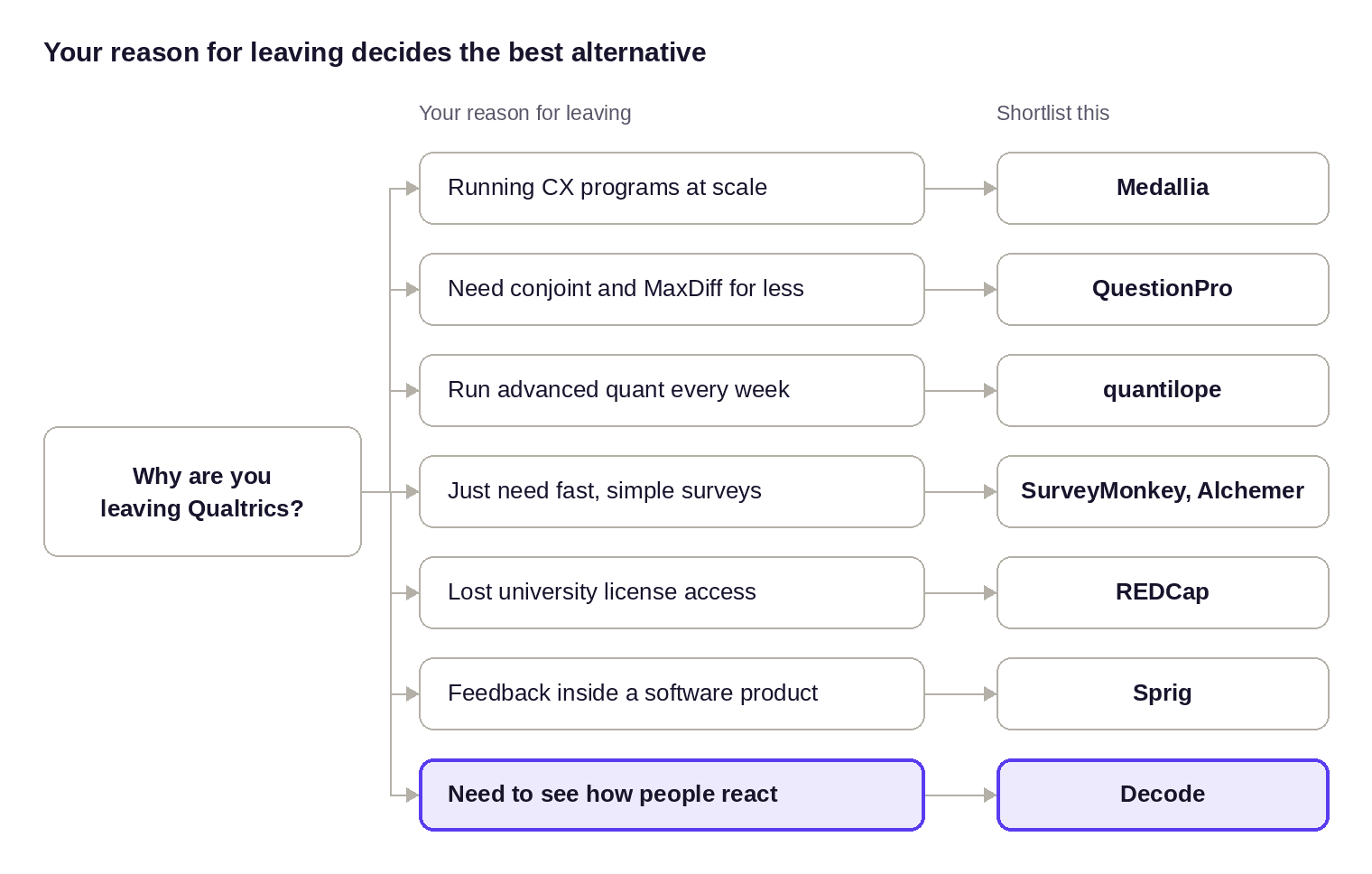
Decision guide: seven reasons for leaving Qualtrics, one shortlist each
Find your reason for leaving on the left, and start your shortlist with the tool on the right. If two reasons apply, the one that matters most to your next big decision should win.
Frequently asked questions
1. Who is Qualtrics’ biggest competitor?
In enterprise customer experience, Medallia is the closest competitor. In research, it depends on the job: QuestionPro and quantilope for advanced survey methods, and Decode for consumer and UX research that measures emotion and attention.
2. Is there a free alternative to Qualtrics?
Yes. SurveyMonkey and QuestionPro both have free plans, REDCap has no license cost for consortium institutions, and Decode has a Free plan with 100 responses a month. Qualtrics itself also offers a free account, limited to 500 total responses and 3 active surveys.
3. How much does Qualtrics cost?
Self-serve Strategic Research costs $420 a month, billed annually ($5,040 a year), for 1,000 responses shared across all users. Higher volumes and enterprise programs are quoted. Pricing as of October 2026.
4. Who owns Qualtrics, and is it still an SAP company?
No. SAP sold Qualtrics to Silver Lake and CPP Investments in 2023. Qualtrics completed its own $6.75 billion acquisition of Press Ganey Forsta in May 2026.
5. Is Qualtrics or REDCap better for academic research?
For clinical and regulated studies, REDCap is usually the better fit, if your institution is a consortium member. For survey experiments and complex survey logic, Qualtrics is stronger, if your university licenses it.
6. Is Decode a good Qualtrics alternative?
For consumer, brand, marketing and UX research, yes. Decode measures how people react (facial coding, eye tracking and voice emotion) in the same study as their answers. Teams that also run CX or employee experience programs often keep a platform such as Qualtrics or Medallia for those, and use Decode for research.
7. Can Decode run quantitative surveys like Qualtrics?
Yes. Decode runs quantitative surveys with 103M+ participants in 151 markets, or with your own audience. It can add emotion and attention measurement to selected responses.
8. Is Qualtrics better than Microsoft Forms?
They solve different problems. Microsoft Forms comes free with a Microsoft account and is included in most Microsoft 365 business and education plans. It’s fine for simple internal surveys. Qualtrics adds advanced logic, quotas, research methods and analytics that Forms doesn’t attempt.
9. What is the most popular survey tool?
Free tools such as Google Forms, Microsoft Forms and SurveyMonkey are among the most widely used. In enterprise research and experience management, Qualtrics is among the most established.
10. When Qualtrics is still the better choice
Qualtrics remains excellent at what it was built for: survey methodology depth, advanced logic and quotas, text analytics, enterprise governance, and CX, EX and research in one platform.
The bottom line
The best Qualtrics alternative is the one that fixes your reason for leaving. For CX at scale, Medallia. For a broad research suite with published pricing, QuestionPro. For simple surveys, SurveyMonkey or Alchemer. For academic work, REDCap.
If what’s missing is how people actually react, see it for yourself. Book a Decode demo and bring a real research question: we’ll run it with an AI research agent, measured on real people.