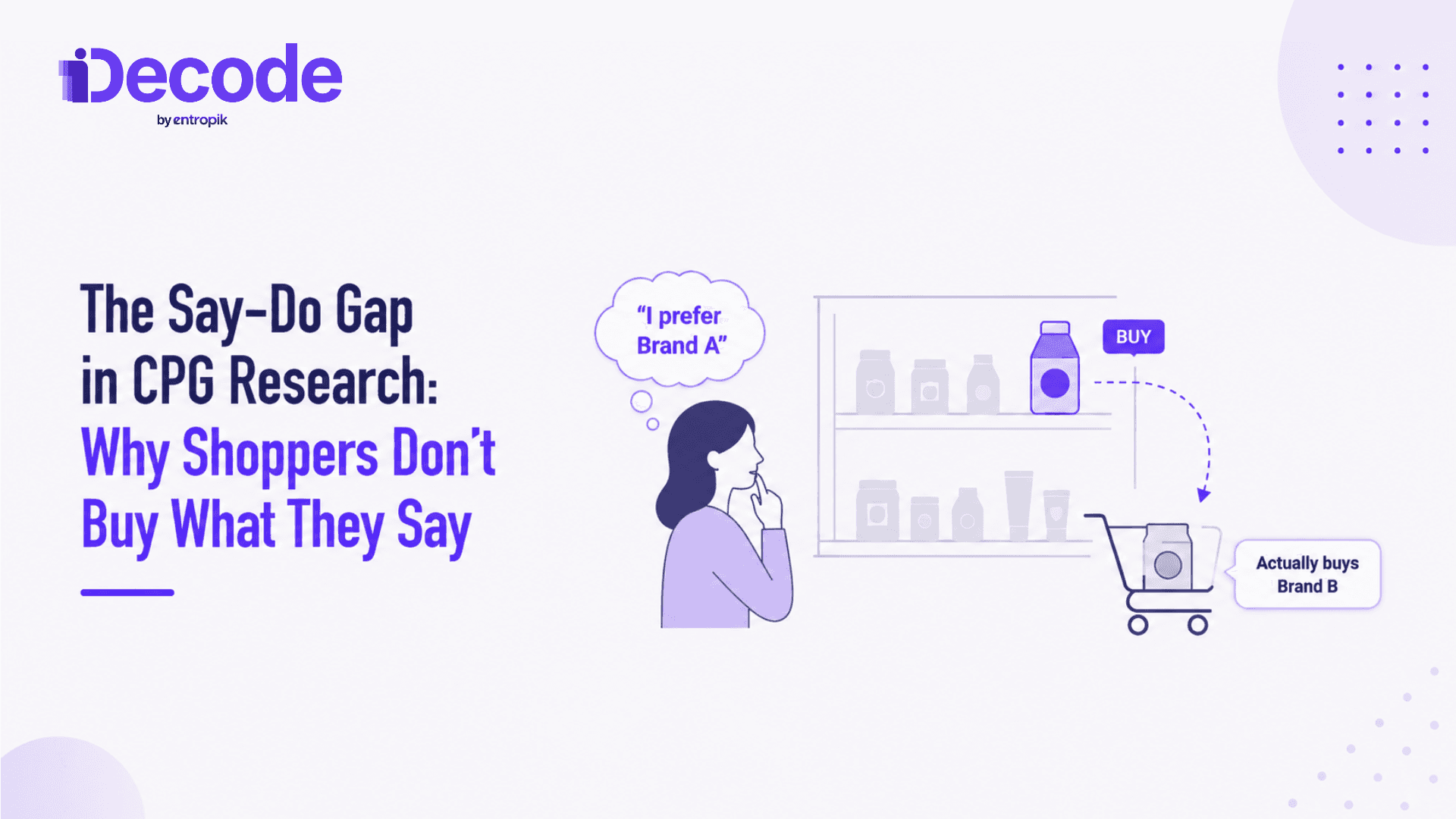
The say-do gap in CPG research is the difference between what shoppers say in surveys and concept tests and what they actually buy at the shelf. It shows up in inflated purchase intent, overstated willingness to pay, and self-reported usage that differs from real behavior. Because CPG launch failure rates are high, this gap makes stated data a weak predictor of velocity.
Summary:
|
A concept scores well. A pack tests strong. A price feels acceptable in the survey. Then the product hits the shelf, and none of it translates into velocity.
This is the say-do gap playing out in one of the industries where it does the most damage. CPG research routinely measures what shoppers claim they'll do, while the shelf measures something else entirely: what they'll actually swap into a routine, pay for, and keep buying. Understanding where this gap shows up across the CPG research toolkit, and how to close it, is the difference between a launch that predicts real sales and one that only predicts good intentions.
What Is the Say-Do Gap in CPG Research?
The say-do gap in CPG research is the distance between what a shopper says in a survey, concept test, or focus group and what actually goes into the basket at the shelf. A shopper can rate a concept favorably, express genuine interest in a new pack, and still walk past that product entirely once it's competing for real attention against a dozen familiar alternatives.
This isn't shopper dishonesty. It's a measurement and context problem. Most research settings strip out the friction of the real decision, the price comparison, the habit being broken, the five seconds of actual shelf time, and replace it with a calm, deliberate moment that doesn't resemble how the purchase actually happens. The shelf is the true test, and it's a test that most pre-launch research fails to recreate.
Why the Say-Do Gap Is So Costly in CPG
Few categories punish overstated intent as harshly as CPG. Thin margins, limited shelf space, and fierce competition for a shopper's attention mean there's very little room for research that predicts a hit that turns out to be a miss.
The scale of the risk is well documented. NielsenIQ's analysis of CPG innovation found that just 52% of new items with national distribution manage to grow their sales in the second year on the market, meaning nearly half of everything that survives an initial launch still fails to build real momentum. That's before accounting for the much larger share of concepts that never make it to distribution at all.
The pattern holds well beyond CPG specifically. McKinsey found that more than 50% of product and service launches fail to hit their business targets, with consumer and retail categories performing worse than the average across sectors studied. In a category built on razor-thin margins and limited shelf space, that failure rate translates directly into wasted trade spend, wasted production runs, and lost distribution that's hard to win back.
What usually drives the miss isn't a flawed product concept. It's a misread of what shoppers will actually swap into their routine, which is a very different question from whether they liked the idea in a research setting.
Where the Say-Do Gap Shows Up in CPG Research
The gap doesn't appear just once in the CPG research process. It shows up at nearly every stage, from the first concept test through post-launch loyalty tracking.
Concept Testing and Purchase Intent
Top-box liking scores get mistaken for real purchase intent more often than most teams realize. A shopper can rate a concept "definitely would buy" in a stripped-down test, disconnected from price, packaging, and the shelf it will actually compete on, and that score still fails to predict conversion once those variables reappear.
The problem is that concept tests remove the exact friction shoppers use to make real decisions. Approval is easy to give in an interview setting. Switching away from a familiar, trusted product is what actually matters, and that's a much higher bar than simply liking an idea. Pairing stated reactions with observed engagement helps close this gap; AI-moderated interviews for concept testing combine structured questioning with behavioral signals in the same session, rather than relying on a stated score alone.
Pack and Shelf Testing
Stated pack preference and real shelf behavior frequently disagree. A design that shoppers rate highest in isolation often isn't the one that actually wins their attention once it's sitting among a dozen competing SKUs on a real shelf.
Claimed standout rarely matches observed visual behavior, because a static rating question can't capture what happens in the first second of a shopper's glance down an aisle. Context is everything here; the same pack that stands out in a clean, isolated test can disappear entirely once package designs that drive purchase intent are evaluated against the real competitive set rather than on their own.
In-Home Usage Tests
Self-reported usage in an IHUT diary rarely matches what actually happens at home. Shoppers forget how often they used a product, round their answers toward what feels reasonable, or unconsciously describe the product the way they intended to use it rather than the way they actually did.
Memory and social desirability distort these diaries in predictable ways. A respondent who used a product twice reports using it daily because that feels closer to their intention; a respondent who disliked a product downplays that reaction because they agreed to participate in the study. Observed behavior, gathered through actual usage tracking rather than recall, consistently surfaces gaps that a written diary misses entirely.
Price and Willingness to Pay
Stated acceptance of a price premium collapses reliably once a real budget and a cheaper alternative enter the picture. A shopper who agrees a premium price feels fair in a survey often reaches for the familiar, cheaper option once that same choice is in front of them at checkout.
Hypothetical pricing questions are a big part of the problem, since there's no real cost to answering generously when nothing is actually being purchased. This is exactly why price testing methods built around realistic trade-offs, rather than a single abstract price question, tend to produce estimates that hold up far better once a product is actually competing for real budgets at the shelf.
Sustainable Product Claims
Sustainability is where the say-do gap shows up most consistently across CPG categories. Shoppers express strong stated preference for sustainable options, then purchase decisions at the shelf tell a very different story.
The size of that gap can be stark. Kantar research on green products found that while 60% of consumers say they're interested in buying green products, less than 18% actually put their money behind that stated interest at retail, a gap that widens further when it comes to repeat purchase. Price, convenience, and lingering doubt about whether a claim is genuine routinely override stated intent once shoppers are standing at the shelf, which makes overstated demand one of the riskiest signals to bet a sustainable innovation launch on.
Repeat Purchase and Loyalty
Stated repeat intent is one of the most reliably overstated metrics in CPG research. A shopper who says they'll buy a product again is describing a hypothetical future decision, not a commitment, and that distinction matters enormously for velocity forecasting.
Reformulation backlash is a useful case study in how this plays out. Negative reviews and social sentiment often surface weeks before a velocity dip shows up in sales data, because claimed loyalty in a brand tracker can mask shoppers who are already quietly switching without saying so directly. Brands working to predict and prevent customer attrition using behavioral and sentiment signals tend to catch this kind of quiet switching well before it fully erodes repeat purchase rates.
Why CPG Shoppers Say One Thing and Buy Another
A handful of underlying forces explain why this pattern repeats across nearly every CPG research moment.
Social desirability inflates answers in focus groups and surveys more than most researchers account for. Shoppers want to appear health-conscious, environmentally responsible, and financially sensible in front of a moderator or a survey screen, and that instinct shapes their answers regardless of what they'll actually do once no one is watching. Common shopper research mistakes often trace back to taking these socially desirable answers at face value instead of designing around them.
Hypothetical framing compounds the problem by stripping out real price, real habit, and real competition from the research setting. Shelf decisions, by contrast, are fast and largelys System 1: automatic, habitual, and driven by split-second visual and emotional cues rather than the deliberate reasoning that a survey question actually captures.
How CPG Teams Close the Say-Do Gap
Closing the gap takes a combined approach rather than a single fix. Each of the following methods addresses a different piece of why stated data drifts from shelf reality.
Test in a Realistic Shelf Context
Recreating the buying moment, rather than showing an isolated concept, is one of the most effective ways to shrink the gap before it opens. Virtual and simulated shelves that include real competitors and real pricing force shoppers to make the same trade-offs they'd make in an actual store.
This kind of realistic simulation is exactly what an interactive shopper research platform is built to recreate, measuring choice under conditions that look and feel like the real shelf rather than a stripped-down concept board.
Force Comparison and Trade-Offs
Choice-based methods that require real trade-offs consistently outperform simple liking or intent questions. Asking whether a shopper would switch away from their current product, rather than whether they like a new one, gets much closer to what actually determines shelf behavior.
Conjoint analysis puts this into practice directly, testing price against the real comparison set instead of in isolation, which produces far more reliable estimates of what a shopper will actually choose once alternatives are genuinely in front of them.
Add Behavioral and Emotion Measurement
Since shelf decisions run on fast, automatic System 1 processing, capturing behavioral and emotional signals fills a gap that stated answers can't close alone. Eye tracking and attention measurement show exactly what shoppers notice on pack and shelf, rather than what they remember noticing afterward.
Facial coding adds a complementary layer, capturing emotional response to packs and ads in real time. Combining these implicit signals with stated feedback, rather than relying on either alone, gives research teams a far more complete picture of what will actually drive a shopper's decision at the shelf.
Tighten Participant Criteria to Category Buyers
Research samples that include non-buyers routinely inflate purchase intent, since someone with no real stake in a category has nothing to lose by answering generously. Screening for real category and segment buyers, and separating heavy buyers, light buyers, and brand switchers, produces far more predictive results.
This kind of precision matters because different buyer segments respond to entirely different cues. Grouping shoppers by behavioral segmentation rather than broad demographic criteria makes it much easier to identify which category buyers are genuinely likely to switch, and which are simply answering a hypothetical question politely.
Validate Against Panel and Velocity Data
No amount of pre-launch testing replaces checking research predictions against what actually happened once a product hit the shelf. Comparing predicted purchase intent to real panel and velocity data, then recalibrating as overstatement patterns become clear, is what turns a one-time study into a system that gets more accurate over time.
Keeping that comparison organized and accessible matters just as much as running it. Teams that build a research repository to track predicted versus real velocity across launches treat their dashboards as prompts to investigate further, not as proof that the research got it right the first time.
Closing the Say-Do Gap in Pack and Shelf Testing with Decode
Closing the gap consistently depends on the accuracy of the technology capturing what stated answers miss.
Eye Gaze Tracking and Attention Measurement show what shoppers actually notice on pack and shelf, reading real attention with up to 96% accuracy rather than relying on what a shopper remembers looking at afterward. Facial Emotion AI captures emotional response to packs and ads as it happens, reading across more than 60 distinct facial expressions with accuracy above 90%, while Voice Emotion AI extends that same read to spoken shopper feedback across more than 70 languages.
Backed by 17 patents and trusted by more than 150 global brands, Decode by Entropik brings these signals together with stated survey and concept data in a single Unified Human Insights Platform, giving CPG research teams a way to test pack, shelf, and concept decisions against what shoppers actually notice and feel rather than what they claim in a survey alone.
For CPG teams building this kind of research capability, this CPG consumer insights guide is a useful starting point.
This overview of Consumer Insights covers the broader research approach behind pairing stated and behavioral data.
A comparison of consumer research software options is a good next stop for teams evaluating tools against their specific shelf and pack testing needs.
For a broader roundup of vendors in this space, this list of consumer research platforms is worth reviewing before making a final decision.
Frequently Asked Questions
1. What is the say-do gap in CPG research?
The say-do gap in CPG research is the difference between what shoppers say in surveys, concept tests, or focus groups and what they actually buy at the shelf. It shows up as inflated purchase intent, overstated willingness to pay, and self-reported usage that doesn't match real behavior.
2. Why do so many CPG product launches fail?
Most CPG launches fail because pre-launch research predicts liking and stated intent rather than actual shelf behavior. Thin margins, intense shelf competition, and short decision windows mean that even small gaps between stated and real purchase behavior can sink a launch.
3. Why is purchase intent unreliable in concept testing?
Concept tests typically strip out price, packaging, and real competing products, which removes the friction shoppers actually use to decide. Top-box liking scores measure approval, not the much higher bar of switching away from a familiar product.
4. How does the say-do gap show up in pack and shelf testing?
Stated pack preference often doesn't match what actually captures shopper attention on a real, competitive shelf. A design that tests best in isolation can lose out entirely once it's evaluated against real competing SKUs.
5. Do in-home usage tests suffer from the say-do gap?
Yes. Self-reported usage in IHUT diaries is distorted by memory limitations and social desirability, leading shoppers to report usage patterns that differ from what actually happened at home.
6. How can CPG teams make pre-launch research predict real sales?
Teams can close the gap by testing in realistic shelf context, using choice-based methods that force real trade-offs, adding behavioral and emotion measurement, screening for genuine category buyers, and validating predictions against actual panel and velocity data after launch.
7. How do eye tracking and facial coding help in CPG research?
Eye tracking shows what shoppers actually notice on pack and shelf, while facial coding captures emotional responses to packaging and advertising in real time. Together they reveal reactions that a stated survey answer alone cannot capture.
8. Does the say-do gap affect sustainable product launches?
Yes, often more than other categories. Shoppers frequently express strong stated interest in sustainable products, but price, convenience, and doubt about the claim's legitimacy commonly override that intent once a real purchase decision is in front of them.
Make pre-launch CPG research predict shelf behavior.
Measure attention and emotion, not just stated intent, at every stage from concept to pack to shelf. Request a Demo and talk to a research expert to see how Decode brings eye tracking, attention measurement, and Facial Emotion AI into your CPG research process