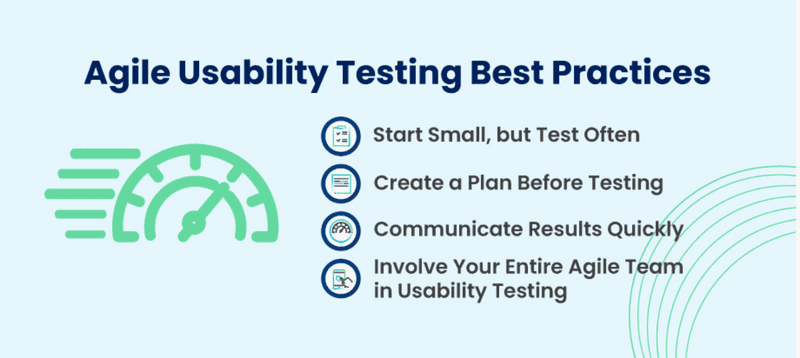
RITE (Rapid Iterative Testing and Evaluation) is a usability testing method where a design is updated immediately after a usability issue surfaces, rather than waiting until an entire study concludes. This lets teams fix problems and retest with the very next participant, making it well suited to fast-paced environments where a prototype or design can still be easily changed.

UX teams rarely have the luxury of long feedback cycles. When a design issue is obvious, waiting until the end of a full study to make a fix can feel slow and wasteful. That is one reason the RITE method has remained relevant for UX teams: it is built around learning fast and improving quickly during usability testing.
RITE stands for Rapid Iterative Testing and Evaluation. The method is designed to help teams identify usability issues early, make changes during the study, and test those improvements with the next participants instead of waiting until all sessions are complete.
In plain terms, the RITE method is a practical way to combine usability testing with rapid iteration. It works best when teams can make quick design updates, observe whether those updates improve the experience, and keep learning as the study progresses.
This guide explains what the RITE method is, how it works, what its goal is, when to use it, and how it compares with more traditional usability testing.
What is the RITE method in UX?
The RITE method in UX is a usability testing approach where researchers and designers make design changes during the testing cycle instead of waiting until the entire study is over.
That is the key idea behind rapid iterative testing and evaluation: test, learn, fix, and test again while the study is still in progress.
In a more traditional usability testing setup, teams usually keep the same design or prototype consistent across all sessions. They observe participants, collect findings, and make changes only after the study is complete. In RITE usability testing, the team still observes carefully, but if a usability problem is clear and actionable, they may fix it before the next participant is tested.
This makes the method especially useful when:
the team is testing a prototype or product flow that can be changed quickly
the issues are visible enough to act on with confidence
the goal is fast learning and improvement, not just documentation
The method is most often used in UX and usability testing because those workflows naturally involve design changes, interaction problems, and immediate opportunities to improve the user experience.
What is the goal of the RITE method?
The goal of the RITE method is to shorten the gap between identifying usability issues and improving the design.
Instead of treating usability testing as a fixed study followed by a separate round of changes, the RITE approach is meant to help teams learn and iterate while the study is still in progress.
In practice, that means the method is designed to help teams:
identify usability issues early
fix clear problems during the study
learn whether those fixes improve the experience
move faster from observation to iteration
This matters because some usability issues are obvious enough to act on quickly. If multiple participants struggle with the same interaction, or if a problem clearly blocks task completion, waiting until the end of the full study may only slow down improvement.
That said, the goal of the method is not to make constant changes after every session. It is to support timely, evidence-based iteration when the issue is clear and the fix can be made responsibly.
How does the RITE method work?
At a high level, the RITE testing method follows a repeating cycle:
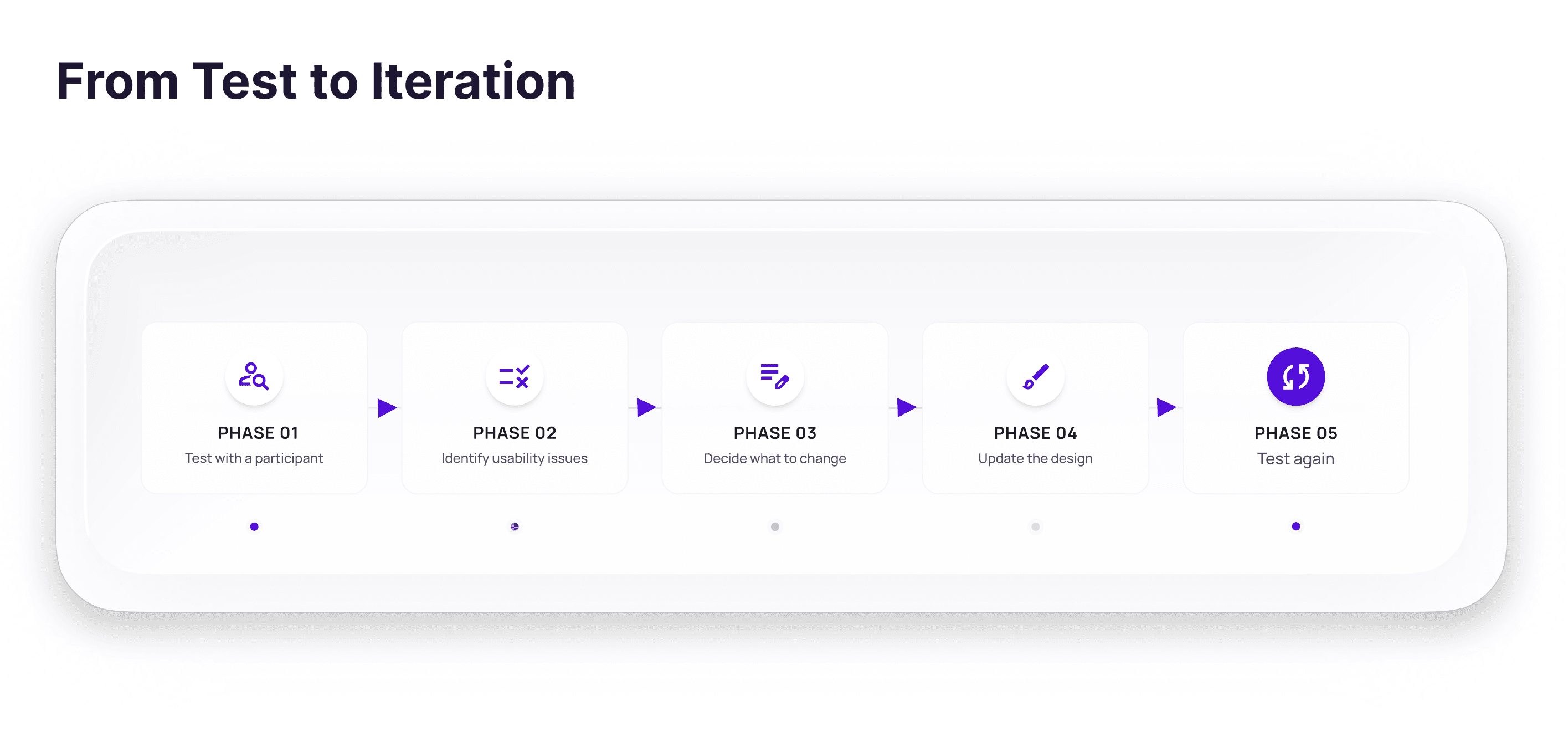
Test the design with a participant
Observe usability issues
Decide whether a change is clear and justified
Make the change quickly
Test the updated version with the next participant
Repeat
That sounds simple, but good RITE testing depends on discipline.
1. Test with a participant
The team runs a usability session using a prototype, product flow, or design concept. The participant works through tasks while researchers observe where confusion, hesitation, or failure happens.
2. Observe problems carefully
The team looks for usability issues that are clear enough to act on. These may include:
unclear labels
confusing navigation
weak visual hierarchy
broken task flows
friction in onboarding, signup, or checkout
3. Decide what to change
This is a critical step. Not every issue should trigger an immediate design update.
Teams should ask:
Is the problem clear enough?
Is the fix straightforward?
Are we confident this is a real usability issue, not a one-off reaction?
Can we make the change without disrupting the study too much?
4. Make the fix
If the issue is strong and the solution is practical, the design is updated before the next session.
5. Test again
The next participant interacts with the revised design. This helps the team see whether the change improved the experience or whether the problem still remains.
This repeated cycle is what makes the method different from a more fixed testing approach. Instead of collecting all the evidence first and acting later, the team learns and iterates in near real time.
When should teams use the RITE method?
The RITE method is not right for every study, but it can be highly effective in the right conditions.
Early usability testing
The method is especially useful when teams are still refining a design and expect issues to surface quickly. Early-stage studies often benefit most because the design is still flexible.
Prototype evaluation
RITE works well when teams are testing prototypes, wireframes, or flows that can be updated quickly between sessions.
Fast-moving product teams
Product and design teams working in short cycles often need faster feedback loops. RITE supports that by turning usability sessions into live opportunities for iteration.
Situations where immediate changes are possible
If the team can quickly edit the design, align on decisions, and document what changed, the method becomes much more practical.
Studies focused on clear usability issues
RITE is most useful when the goal is to identify and fix usability problems. It is less suited to broader exploratory research where the main need is deep understanding rather than rapid design improvement.
In short, use the RITE method when speed matters, design changes are feasible, and the study is focused on usability rather than broad discovery.
Benefits of the RITE method in UX
The RITE method continues to be useful because it gives teams a faster path from usability findings to design improvement.
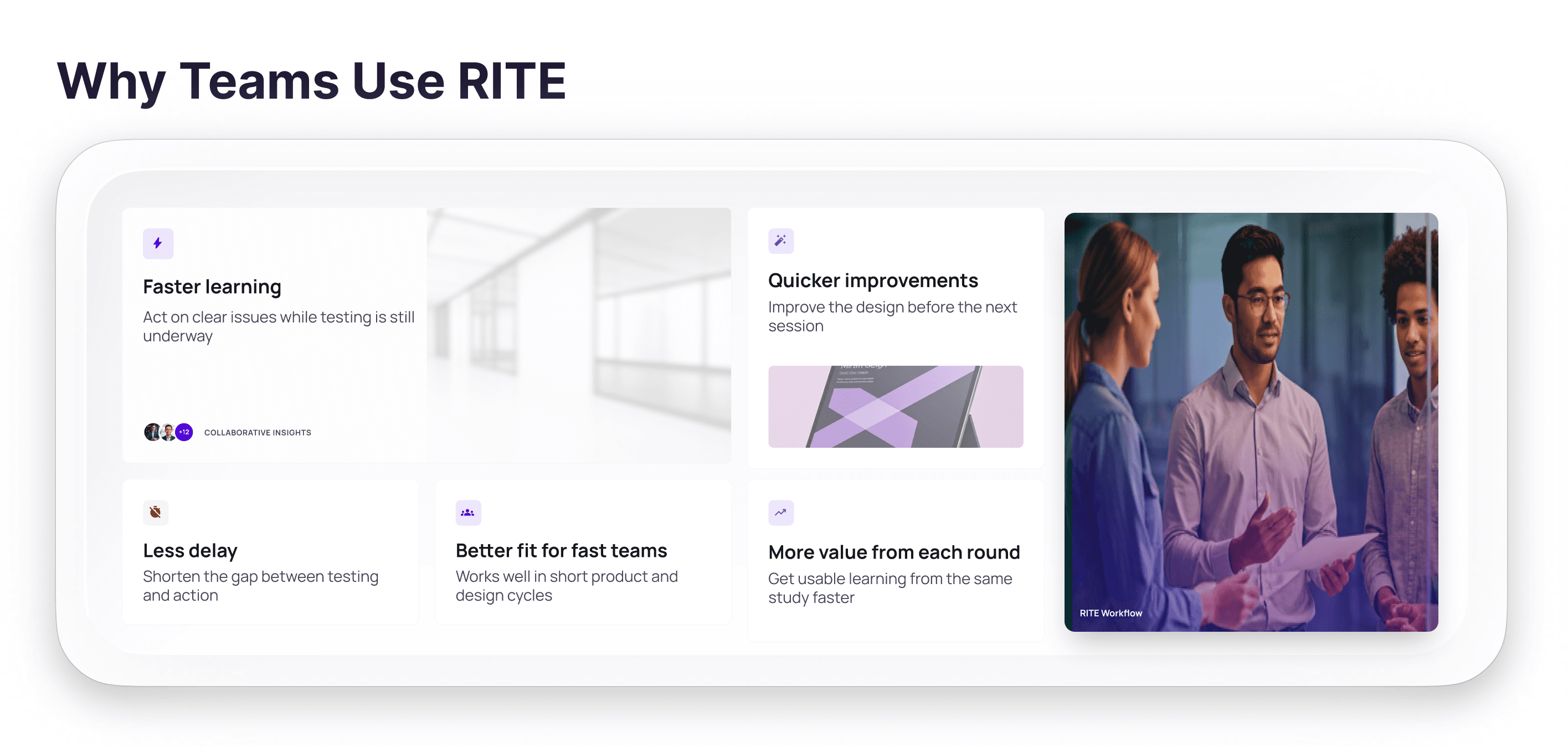
Faster learning
Teams do not have to wait until the end of the study to act on clear issues. They can learn and adjust while testing is still underway.
Quicker design improvements
When a usability problem is obvious and the fix is practical, the team can improve the design before the next session.
Less delay between testing and action
Traditional studies often create a gap between identifying a problem and making a change. RITE reduces that delay.
Strong fit for iterative product teams
Teams already working in short product or design cycles often find the method easier to fit into their workflow than slower testing formats.
More practical value from each round of testing
Because the design can improve during the study, teams may get more usable learning from the same round of sessions.
For teams that value speed and iteration, RITE can feel more action-oriented than a standard test-report-redesign sequence.
Limitations of the RITE method
The method is useful, but it has real tradeoffs.
It is not ideal when changes are hard to make quickly
If the design cannot be updated between sessions, the value of the method drops. RITE depends on the ability to iterate during the study.
It can create inconsistency across participants
This is one of the biggest limitations. If the design changes between sessions, not every participant is seeing the exact same version. That means the study is less controlled than traditional usability testing.
It may not suit every research question
If the goal is deep exploration, concept discovery, or a tightly controlled comparison across participants, RITE may not be the best fit.
It requires careful documentation
Teams need to track:
what changed
why it changed
when it changed
which participants saw which version
Without that discipline, the study can become messy and harder to interpret.
It can encourage rushed decisions
If teams move too quickly without enough confidence, they may overreact to one participant or make changes that are not actually solving the right problem.
So while RITE can be powerful, it works best when speed is balanced with sound judgment.
RITE method vs traditional usability testing
The clearest difference between the RITE method and traditional usability testing is when changes happen.
In traditional usability testing
the design usually stays fixed during the study
all participants see the same experience
changes happen after findings are reviewed across sessions
In the RITE method
the team may change the design during the study
later participants may see a revised version
iteration happens alongside testing
That creates a real tradeoff.
Where RITE is stronger
when teams need speed
when usability issues are clear
when prototypes or flows can be updated quickly
when the goal is rapid improvement
Where traditional usability testing is stronger
when consistency across sessions matters more
when the team wants a more controlled comparison
when changes are difficult to implement quickly
when the research question is broader than usability fixes
Neither method is universally better. The right choice depends on what the team is trying to learn and how quickly they need to act.
What does a RITE method example look like?
A simple RITE method example helps make the process more concrete.
Imagine a product team testing a signup flow for a new app.
Session 1
The first participant reaches the signup screen and hesitates. They do not understand the difference between two call-to-action options. They choose the wrong path and get stuck.
The team reviews the issue and agrees that the problem is clear: the labels are confusing, and the fix is straightforward.
Between sessions
The designer updates the screen:
the CTA labels are simplified
the visual hierarchy is improved
one unnecessary option is removed
Session 2
The next participant sees the updated version. They move through the screen more smoothly, but now hesitate on the password requirements section.
Again, the team reviews the issue. If it is clear enough, they may refine that part before the next participant.
Session 3 and beyond
The design keeps improving as major usability issues are identified and fixed between sessions.
This example shows why the method is useful. Instead of waiting until the end of the full study, the team is already learning which changes help and which issues still remain.
How to run the RITE method effectively
If you want the method to work well, speed alone is not enough. Good RITE practice depends on clear decisions, disciplined documentation, and the ability to distinguish obvious issues from one-off reactions.
A few principles help:
Fix only what is clear
Do not change the design after every small reaction. Focus on issues that are repeated, obvious, or clearly blocking usability.
Document every change
Track what changed, why it changed, and which participants saw each version. Without that, the study becomes harder to interpret.
Keep the team aligned
Researchers, designers, and product stakeholders need quick but thoughtful decision-making. Without alignment, the process can become messy.
Use it for the right kind of study
RITE works best in practical usability testing, especially when the team can make and review changes quickly.
Know when not to change the design
Not every issue needs an immediate fix. Some findings are better captured and addressed after the study when there is more evidence.
These are often the most useful questions teams should ask during planning:
Can we make changes quickly?
Will the changes be easy to document?
Are the likely issues clear and actionable?
Do we need strict consistency, or do we need faster iteration?
Final thoughts
The RITE method is valuable because it helps turn usability testing into a more active learning loop. Instead of waiting until the study is finished, teams can identify problems, improve the design, and keep testing while the work is still in motion.
That makes the method especially useful for prototype evaluation, early usability testing, and fast-moving product teams that need to move from feedback to action quickly.
At the same time, it is not the right fit for every workflow. Because changes happen during the study, consistency becomes harder to maintain. That means the method works best when the team is disciplined, the design is easy to update, and the research goal is focused on usability improvement rather than broad exploration.
Used in the right context, rapid iterative testing and evaluation can be a practical and effective way to speed up usability learning without waiting for a full study cycle to finish.
FAQs
What is the RITE method in UX?
The RITE method in UX is a usability testing approach where teams make design changes during the testing cycle rather than waiting until the study is complete.
What does RITE stand for in usability testing?
RITE stands for Rapid Iterative Testing and Evaluation.
What is the goal of the RITE method?
The goal is to identify usability issues quickly, make improvements during the study, and shorten the gap between testing and design changes.
When should you use the RITE method?
Teams should use it when they are testing designs that can be changed quickly, especially in early usability testing, prototype evaluation, and fast-moving product workflows.
How is the RITE method different from traditional usability testing?
Traditional usability testing usually keeps the design fixed across all sessions, while the RITE method allows teams to make updates between sessions when issues are clear and actionable.
See how teams can run faster UX research workflows and move from testing to action more efficiently.
Related Topic: