Choosing the right UX research method means working backward from the specific question you need answered rather than picking a familiar technique by default. Interviews and field studies suit early-stage discovery, usability and A/B testing suit evaluation closer to launch, and the best method is often the one that gives a useful signal within your team's actual time and resource constraints.

There is no single best UX research method for every situation. The right method depends on what your team needs to learn, what stage the product is in, and what kind of decision you need to make next.
A method that works well for early discovery may be the wrong choice for validating usability before launch. A method that gives deep qualitative insight may not be the best fit when you need broad quantitative confidence.
That is why understanding UX research methods matters. The goal is not to memorize a long list of techniques. The goal is to know which method helps answer which kind of question, and when to use it.
This guide breaks down the most common UX research methods, how they differ, and how to choose the right one with more clarity.
What are UX research methods?
UX research methods are the structured ways teams learn about users, their behaviors, their needs, and their experiences with a product or service.
Some methods help you explore problems early. Others help you test whether a design works. Some methods tell you what users say. Others show you what users actually do. That is why teams use different user research methods for different goals.
At a simple level, a UX research method helps answer one or more of these questions:
What problem do users have?
What do users need or expect?
How do users behave in a real task or journey?
Where are users getting confused or stuck?
Which design direction works better?
How confident are we in this decision?
So UX research is not just one activity. It is a set of UX methods that help teams reduce guesswork and make better product decisions.
Why choosing the right UX research method matters
Different methods answer different questions. If you choose the wrong method, you can still collect data, but the insight may be weak, incomplete, or misleading.
For example:
Interviews are helpful when you want to understand needs, motivations, or attitudes.
Usability testing is better when you want to observe whether users can complete tasks.
Surveys are useful when you need broader input from more people.
Analytics help when you want to see what users are doing at scale.
This is why choosing the right method matters. It saves time, improves decision quality, and helps teams avoid solving the wrong problem.
In practice, the best method is usually the one that matches:
the stage of the product
the kind of question you are asking
the type of evidence you need
the time and resources available
The point is not to choose the most impressive method. It is to choose the one most likely to help you learn what you actually need to know.
The main types of UX research methods
Before getting into specific methods, it helps to understand the broader categories. This makes the landscape of types of user research much easier to navigate.

Qualitative vs Quantitative
Qualitative UX research methods help you understand why something is happening. They are useful when you need depth, nuance, and explanation.
Examples include:
user interviews
diary studies
field studies
moderated usability testing
Quantitative UX research methods help you understand how often, how much, or how many. They are useful when you need measurable patterns or broader validation.
Examples include:
surveys
A/B testing
analytics review
large-scale unmoderated testing with metrics
Attitudinal vs Behavioral
Attitudinal methods capture what users say, think, or feel.
Examples include:
interviews
surveys
concept testing
Behavioral methods focus on what users actually do.
Examples include:
usability testing
analytics
session review
field observation
Generative vs Evaluative
Generative research helps teams explore a problem space and identify user needs before decisions are made.
Examples include:
interviews
field studies
diary studies
Evaluative research helps teams assess something that already exists, such as a prototype, flow, feature, or live experience.
Examples include:
usability testing
A/B testing
benchmark studies
Understanding this basic UX research methodology makes it easier to choose the right method later.
Common UX research methods and when to use them
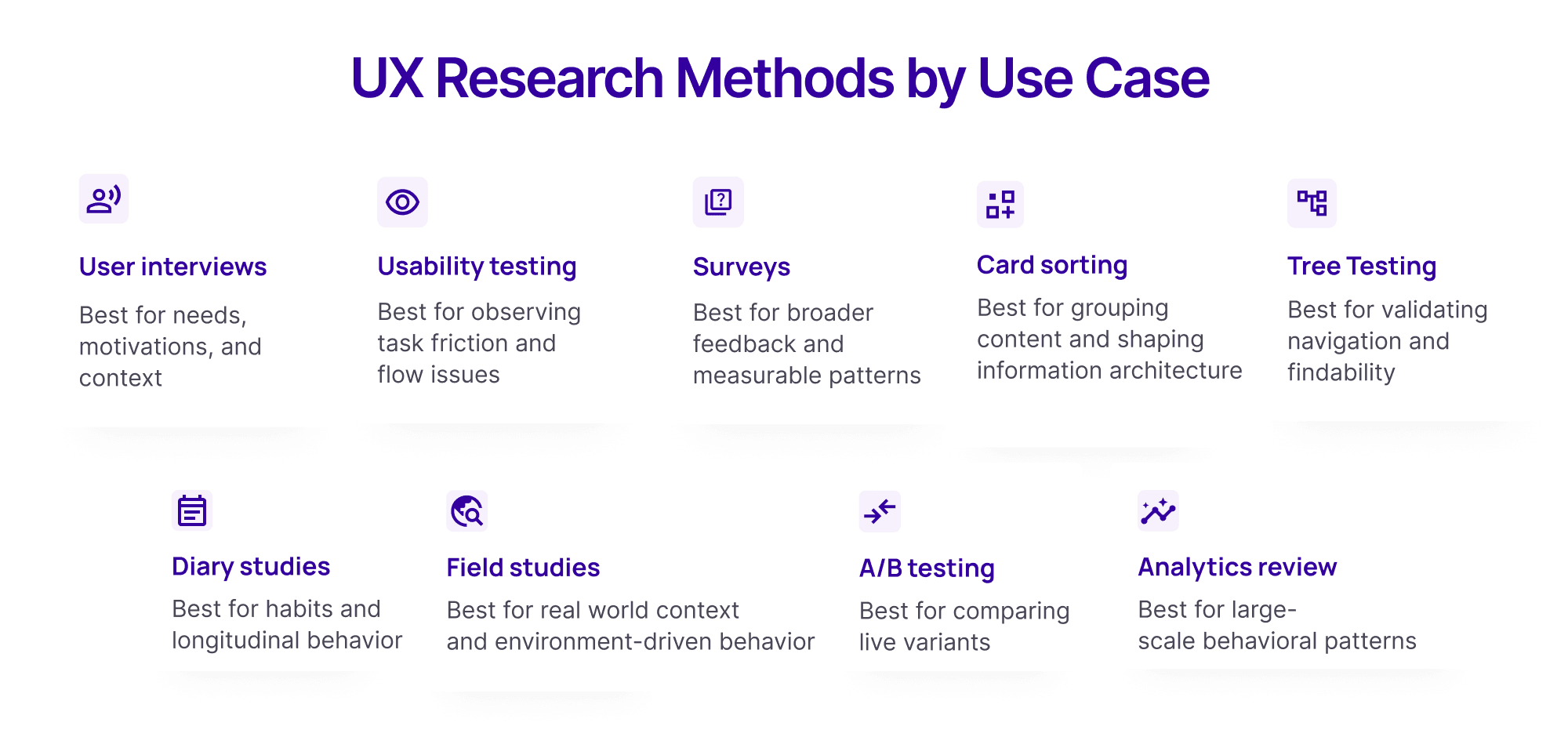
This is the core set of different UX research methods most teams use.
User interviews
User interviews are one of the most common UX research techniques. They are best for exploring needs, behaviors, motivations, expectations, and pain points in depth.
Use interviews when:
you are in early discovery
you need richer context
you want to understand how users think about a workflow or problem
you are exploring unmet needs
Less suitable when:
you need to observe actual task performance
you need statistically broad answers
users may struggle to accurately describe what they really do
Usability testing
Usability testing helps you observe how users interact with a design, prototype, or live product.
Use usability testing when:
you want to find friction in flows or tasks
you need to validate a design before launch
you want to understand where users get confused
you need direct behavioral evidence
Less suitable when:
you are still trying to understand the broader problem space
you need large-scale market sizing or opinion collection
Surveys
Surveys help you collect responses from more users quickly. They are useful for measuring attitudes, preferences, satisfaction, or trends across a larger group.
Use surveys when:
you need broader input
you want to quantify patterns
you want to validate something seen in qualitative research
you need structured feedback across segments
Less suitable when:
you need deep explanation
you are exploring something users may not articulate well on their own
Card sorting
Card sorting helps teams understand how users group and label information.
Use card sorting when:
you are designing or improving information architecture
you need input on navigation categories
you want to understand user mental models for grouping content
Less suitable when:
you need to evaluate a full workflow
the issue is more about task completion than content organization
Tree testing
Tree testing helps validate whether users can find information within a proposed structure.
Use tree testing when:
you want to test navigation logic
you need to validate category structure
you want to assess findability before UI design is finalized
Less suitable when:
the problem is visual or interaction-based
you need broader attitudinal feedback
Diary studies
Diary studies help teams understand behavior over time.
Use diary studies when:
the experience unfolds across days or weeks
you want to study habits, routines, or longitudinal behavior
the context of use changes over time
Less suitable when:
you need quick answers
the product interaction is short and task-based
Field studies or contextual inquiry
These methods help teams observe users in their actual environment.
Use them when:
context matters a lot
environment affects behavior
workflows are complex or tied to real-world settings
you need richer observational insight
Less suitable when:
remote or fast research is the priority
the question can be answered more efficiently with simpler methods
A/B testing
A/B testing is useful when you want to compare live variants and measure which one performs better.
Use it when:
you have enough traffic
you are comparing alternatives in a live product
the decision is measurable through behavior
Less suitable when:
you do not yet understand the user problem
traffic is too low
you need explanation, not just performance difference
Analytics and behavioral review
Analytics help teams understand what users are doing at scale.
Use analytics when:
you want to identify drop-offs or friction points
you need large-scale behavioral patterns
you want to support or challenge assumptions with product data
Less suitable when:
you need to understand why users behave a certain way
you need deeper motivations, not just patterns
These are some of the most common UX research methods examples, but the right choice always depends on what the team needs to learn.
How to choose the right UX research method
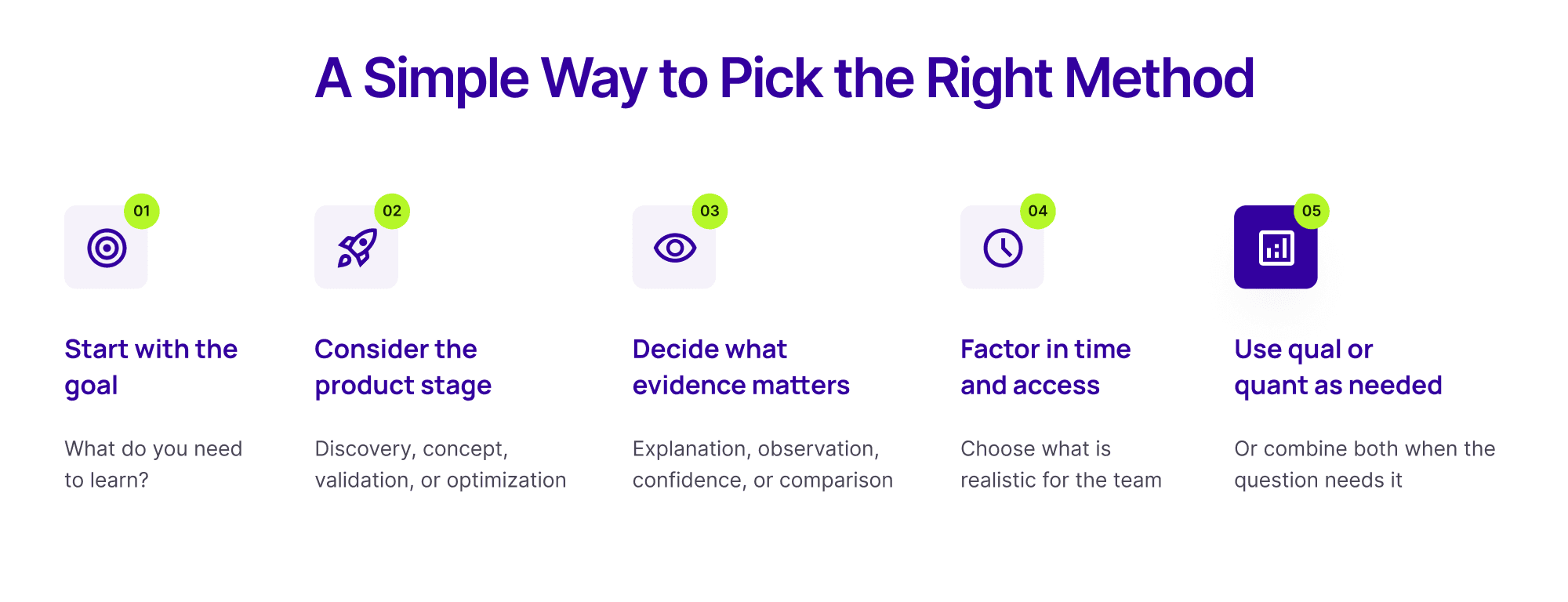
The easiest way to choose the right method is to work backward from the question.
Ask yourself:
What is the research goal?
Are you trying to:
explore a problem
understand needs
validate a design
measure behavior
compare alternatives
If the goal is discovery, interviews or field studies may fit.
If the goal is evaluation, usability testing or A/B testing may fit better.
What stage is the product in?
Early-stage ideas usually need exploratory methods.
Mid-stage concepts may need concept testing or interviews.
Near-launch flows often benefit from usability testing or quantitative validation.
What kind of evidence do you need?
Do you need:
explanation
observation
broad confidence
measurable comparison
This is often the fastest way to answer the question: which UX research method to use.
How much time and access do you have?
Some methods are deeper but slower. Others are faster but lighter. The best method is not always the most rigorous one in theory. It is often the one that gives useful signal within the constraints your team actually has.
Do you need qualitative or quantitative evidence?
Sometimes one is enough. Sometimes the best approach is to combine both.
A practical rule:
use qualitative methods to understand the problem
use quantitative methods to validate scale or confidence
Qualitative vs Quantitative UX research methods
This distinction matters because teams often default to one side too heavily.
When qualitative methods are better
Use qualitative methods when you need:
depth
context
motivations
explanation
open-ended discovery
Good examples include:
user interviews
diary studies
field studies
moderated usability testing
When quantitative methods are better
Use quantitative methods when you need:
scale
confidence across a larger sample
measurable comparison
behavioral signals across many users
Good examples include:
surveys
A/B tests
analytics review
larger-sample unmoderated studies
When to combine both
Often the strongest research approach is mixed.
For example:
use interviews to uncover why users struggle
then use surveys to validate how widespread the issue is
use usability testing to observe the problem directly
use analytics to see how it appears in real product behavior
That is why the best research plans do not treat qualitative UX research methods and quantitative UX research methods as competing options. They are often complementary.
Pros and cons of common UX research methods
All methods come with tradeoffs. Looking at UX research methods pros and cons helps teams avoid unrealistic expectations.
Interviews
Pros: rich depth, flexible, great for discovery
Cons: smaller samples, more time-intensive, relies on self-report
Usability testing
Pros: direct observation, actionable design insight, strong for evaluative work
Cons: narrower scope, smaller sample sizes, less useful for broader attitudes
Surveys
Pros: scalable, structured, good for quantifying patterns
Cons: limited depth, depends heavily on question design
Card sorting / tree testing
Pros: useful for information architecture, relatively efficient
Cons: limited to navigation or structure questions
Diary studies
Pros: strong for longitudinal behavior, real-world context
Cons: slower, higher participant burden, harder to manage
A/B testing
Pros: behavioral evidence, direct comparison in live environment
Cons: needs traffic, weaker for understanding why
Analytics
Pros: scalable, strong behavioral signal, good for identifying patterns
Cons: often weak on explanation without complementary research
No method is universally best. Every method trades off depth, speed, cost, confidence, or realism.
Final thoughts
The best UX research method depends on the question you are trying to answer. Strong research does not come from defaulting to the most familiar method. It comes from choosing intentionally.
That is why understanding UX research methods matters. It helps teams move from habit-driven research to decision-driven research. When you know what each method is good for, when to use it, and where its limits are, you can build stronger studies and make better product decisions with more confidence.
FAQs
What are UX research methods?
UX research methods are structured ways teams learn about users, their behaviors, needs, and experiences with a product or service.
What are the most common UX research methods?
Common UX research methods include user interviews, usability testing, surveys, card sorting, tree testing, diary studies, field studies, A/B testing, and analytics review.
How do I choose the right UX research method?
Choose the right method based on your research goal, product stage, type of question, type of evidence needed, and practical constraints like time and access.
What is the difference between qualitative and quantitative UX research methods?
Qualitative methods help explain why something is happening, while quantitative methods help measure how often or how broadly something is happening.
When should I use usability testing instead of interviews?
Use usability testing when you want to observe task performance or find interaction friction. Use interviews when you want to understand motivations, expectations, and broader context.
What are the pros and cons of different UX research methods?
Each method has tradeoffs around speed, depth, realism, cost, and confidence level. The best choice depends on the decision you need to make.
See how teams can run UX research more efficiently and turn findings into clearer product decisions.
Related Topic: